














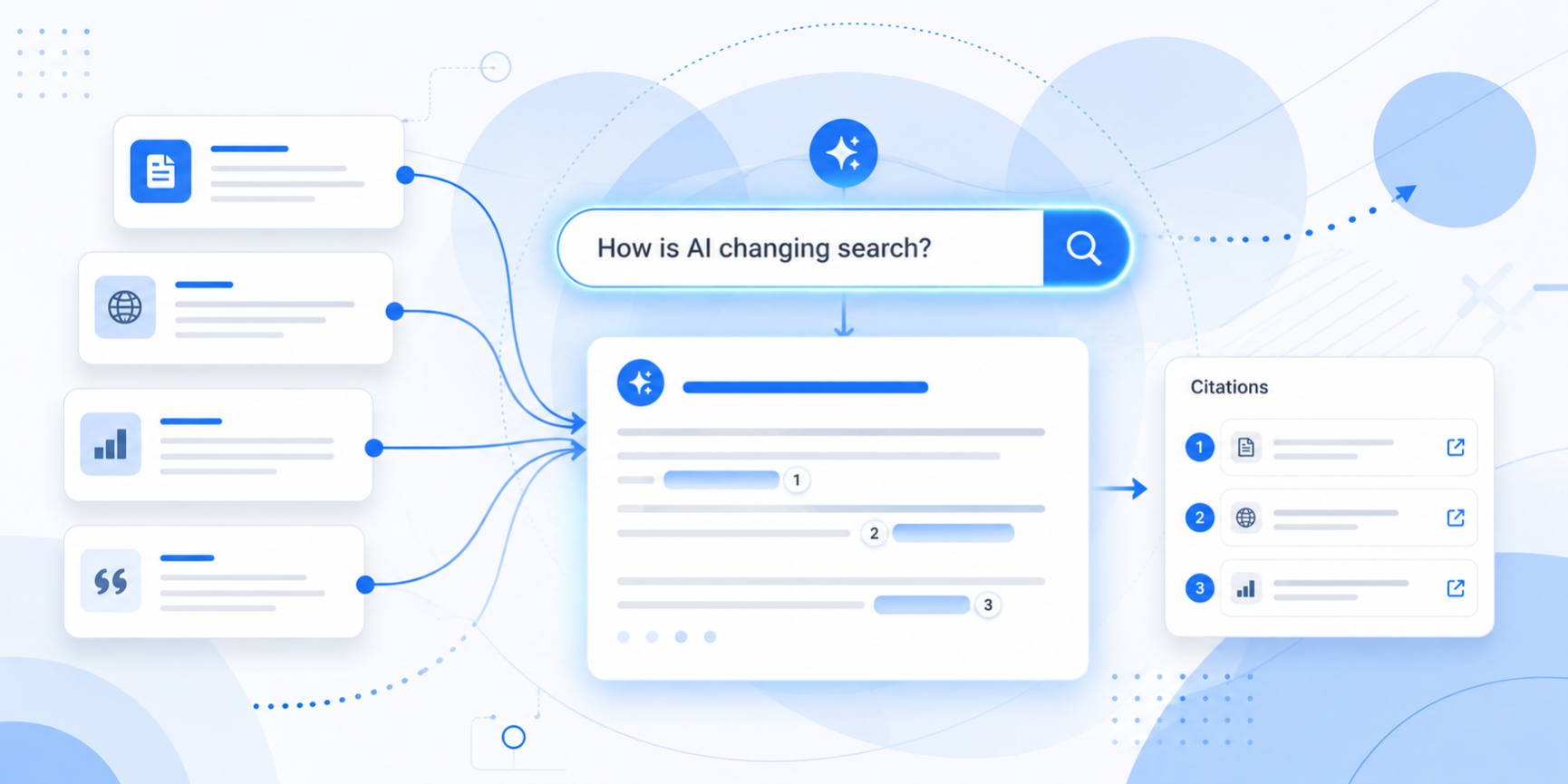
Two years ago, ranking #1 on Google meant traffic. By 2026, ranking #1 doesn’t always mean anything, because Google is answering the question before anyone clicks. The brands cited inside the AI Overview get the traffic. Everyone else gets the seat below it, watching.
Ranking #1 used to be the goal. In 2026, getting cited is.
That isn’t hyperbole. Per Seer Interactive’s research, the overlap between top-10 Google rankings and AI Overview citations collapsed from 76% in mid-2025 to between 17% and 38% in 2026. Ranking high and getting cited used to be the same thing. They’re not anymore.
The scale is the rest of the story. AI Overviews now appear on roughly 48% of Google searches (Search Engine Land), reaching 2.5 billion monthly active users as of Google I/O 2026. Brands cited inside an AI Overview earn 35% more organic clicks and 91% more paid clicks than uncited competitors on the same query (Seer Interactive). Brands that aren’t cited lose ground even when their classic SEO is working.
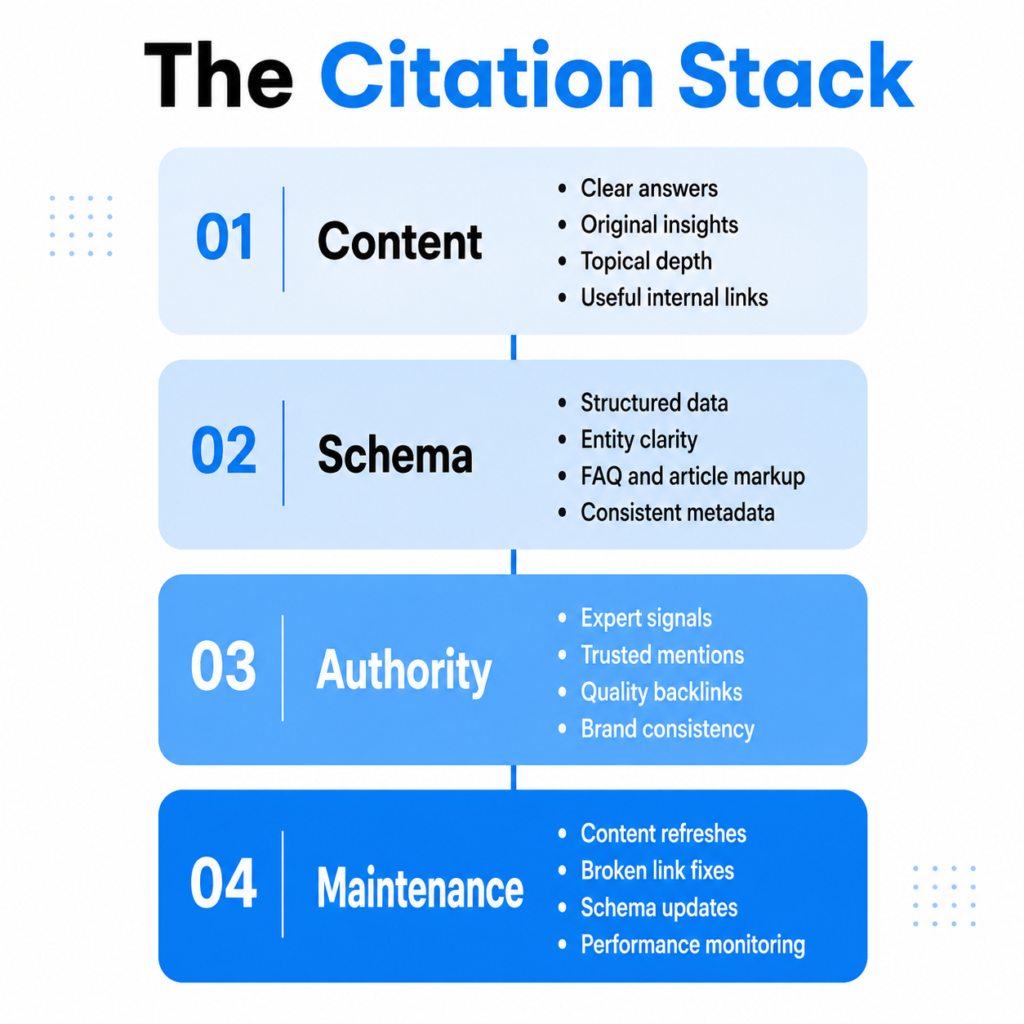
The good news: getting cited isn’t a mystery. It’s a set of techniques. This article walks through ten of them, grouped into what we call The Citation Stack.
Quick disclosure: this article is structured as a working example of every technique it describes. You can verify each one by viewing the page source.
Key Takeaways
- The Citation Stack is a ten-move framework for getting cited by AI search engines including Google AI Overviews, ChatGPT, and Perplexity.
- AI Overviews now appear on roughly 48% of Google searches (Search Engine Land) and reach 2.5 billion monthly active users.
- Brands cited inside an AI Overview earn 35% more organic clicks and 91% more paid clicks than uncited competitors (Seer Interactive).
- The overlap between top-10 Google rankings and AIO citations dropped from 76% in mid-2025 to 17–38% in 2026. Ranking and citation are now distinct disciplines.
- The fastest path to citation: question-shaped headings, direct answers in the first paragraph, and complete schema markup.
- Author authority is no longer optional. Named, credentialed authors with verifiable web presence get cited. Anonymous content rarely does.
What are AI Overviews and how do they choose what to cite?
Google AI Overviews are AI-generated summary boxes that appear at the top of Google search results, synthesizing answers from a small handful of cited sources. They cite content based on a mix of signals: ranking authority for the underlying query, the clarity of structured data, explicit named authorship, content depth and originality, recency, and whether the page contains a clean, extractable answer to the specific sub-question the AI needs to lift.
ChatGPT Search, Perplexity, and Bing Copilot work similarly. They crawl and index web content, then cite specific sources inline when answering a user’s question. The same techniques that get a page cited in Google’s AI Overview generally make it cite-worthy across the rest of the AI search ecosystem too.
A few things changed materially in 2026 that anyone optimizing for AI search should know.
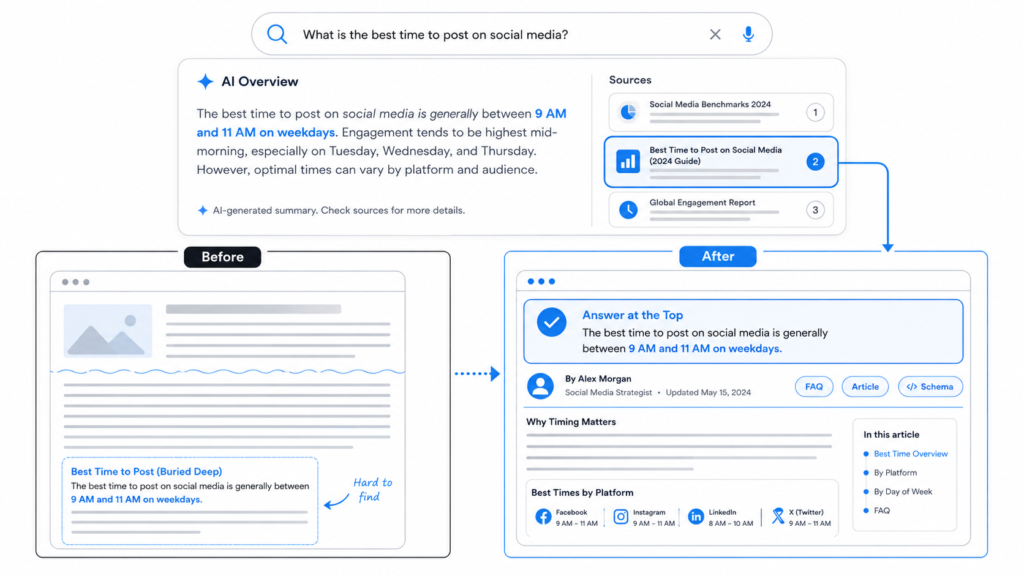
Google’s May 6, 2026 update was the biggest structural change to AI Overviews since launch. Inline citations now sit next to the specific text they support. Hover previews on desktop show site names. A new “Expert Advice” block pulls first-hand perspectives from forums, social media, and review sites. AI Overviews now also highlight when cited information comes from a publication the user subscribes to. Each of those changes raises the bar on what cite-worthy content looks like.
The other shift worth naming: ranking and citation are no longer the same job. A page can be the #1 organic result on a query and still not be cited in the AI Overview above it. Per Seer Interactive’s data, the overlap between top-10 rankings and AIO citations dropped from 76% in mid-2025 to between 17% and 38% by 2026. The AI is choosing differently than the algorithm that ranks the blue links below.
That’s why a dedicated framework matters. Optimizing for ranking doesn’t automatically optimize for citation. The Citation Stack below is the optimization layer that addresses citation specifically.
How do you get cited by Google AI Overviews and ChatGPT?
The Citation Stack is ten moves organized across four layers: Content, Schema, Authority, and Maintenance. Each layer addresses a different signal AI engines use to decide who gets cited. Skip a layer and the rest of the Stack works at reduced strength. Implement all four and the article you’re optimizing becomes cite-worthy by structural design, not by luck.
Here’s the Stack, layer by layer.
Layer 1: Content
The content layer is how your writing itself is structured. This is where most agencies stop optimizing. It’s also where the highest-leverage moves live.
Question-headed sections with direct 40–60 word answers
Phrase every H2 as the exact question a user would type into Google. Then make the first paragraph a self-contained, 40–60 word answer the AI can lift verbatim. If your section opens with an introduction or anecdote, the AI has nothing clean to extract.
Definition-led key terms
Define every key term in a standalone sentence. “X is Y” sentences become the citation source for “what is X” queries. Definitions buried inside multi-purpose paragraphs don’t get extracted.
Numbered, structured lists
Lists are easier for AI to extract as discrete claims than equivalent prose. If content can be expressed as a list, express it as a list.
Comprehensive content depth
Cover the question, the sub-questions, the edge cases. 2,000 words of depth beats 4,000 words of fluff. AI Overviews preference sites that are clearly the deepest source on a topic.
Layer 2: Schema
Schema is the technical markup that tells AI engines what your content actually is. Without it, the AI is guessing. With it, you’ve labeled every part of your page in the language AI understands.
Full schema markup stack — Article, FAQPage, HowTo, Person
Implement Article schema for the page itself (with proper author, datePublished, and dateModified), FAQPage schema on Q&A sections, HowTo schema on instructional content, and Person schema on the author with sameAs links to public profiles. Apply at least the relevant subset to every page.
Article schema is the foundation. It tells AI engines what the page is, when it was published, when it was last modified, and who wrote it. A working block:
FAQPage schema goes on the Q&A section of any page that has one:
Each JSON-LD block goes in the <head> of your page. Add a Question/Answer object for every FAQ you publish. The AI engine reads these directly and treats each Q&A as a discrete extractable claim. Run any page through Google’s Rich Results Test to verify schema is parsing correctly.
Layer 3: Authority
The authority layer is who’s behind the content. Anonymous content rarely gets cited for queries that touch expertise. AI engines need to identify the author as a verifiable entity connected to other authoritative signals.
Named author with Person schema
Real byline. Real role. Public web presence. Person schema with sameAs linking to LinkedIn and any other public author profiles. The author has to be findable across the web, not just on your site.
A working Person schema block:
The sameAs array is what builds the author’s entity graph. Google and the AI engines cross-reference those links to confirm the author is a real, public, findable person. Anonymous content with no Person schema and no sameAs graph reads to the AI as a content farm.
Inline sourced statistics
Every quantitative claim should link to its primary source within the same paragraph. Citing authoritative sources is itself a citation signal. It tells the AI engine your content is part of a connected information graph, not a closed loop.
Layer 4: Maintenance
Maintenance is what separates one-time optimization from compounding citation visibility. Content goes stale. AI engines deprioritize stale content. The maintenance layer keeps the Stack working over time.
Recency signals
Publish dates, modified dates, year in the title where it fits. Update dateModified when you genuinely refresh content. AI engines preferentially cite recent content for queries where recency matters, which is most of them.
Internal linking to topic clusters
Topic authority compounds at the site level, not just the page level. AI engines pattern-recognize topical depth across a domain. A site with twelve interlinked articles on AI search gets treated differently than a site with one isolated article on the same topic. Build clusters. Link aggressively between related pages with descriptive anchor text.
Remove accessibility blockers
Aggressive popups, paywalls, slow load times, and broken mobile layouts reduce citation eligibility. If a human reader can’t easily get to your content, the AI crawler treats it the same way. Standard accessible web hygiene, applied with discipline.
How do I know if my content is being cited in AI Overviews?
Track AI Overview citation through a combination of Google Search Console, dedicated third-party AIO trackers, manual SERP testing on your target queries, and brand mention monitoring to catch citations across ChatGPT and Perplexity. No single tool gives you the complete picture. The mature approach combines all four.
Start with Google Search Console. GSC now reports AI Overview impressions and clicks in most regions where AIO is live. Go to Performance → Search Results and look for the AI Overview filter under Search appearance. It will show you how often your content is being cited and what traffic that citation is producing. GSC is the ground-truth signal for queries you’re already winning. It will not tell you what queries you’re missing or who’s being cited instead of you.
Add a dedicated AIO tracker for breadth. Strong options in 2026 include Otterly.AI (purpose-built for AIO + ChatGPT visibility), Keyword.com (good for tracking citation rate over time), SE Ranking (broader SEO suite with AIO tracking added), Rankability (white-label reporting for agencies), and Ahrefs (added AIO citation tracking in early 2026). For a single business tracking under 100 queries, Otterly.AI is the cleanest starting point. For agencies tracking many clients, Rankability or Ahrefs makes more sense.
Run a manual check weekly on your highest-priority queries. Open an incognito window. Search your top 10–20 target queries. Note which AI Overview is firing, which sources are cited, and where your content sits in the citation list. This takes 15 minutes and surfaces patterns no automated tool catches — particularly when AI Overview composition shifts week to week.
Monitor brand mentions across ChatGPT and Perplexity. Tools like Brand24, Mention, and Otterly’s AI-specific tracker catch when your brand or article is cited in a conversational AI response that wouldn’t appear in any classic search report.
One realistic expectation: AIO citation behavior shifts weekly. Optimize structurally, then watch patterns over months, not days. If you’re citation-shaped and ranking-shaped, the citations will compound.
How Running Robots uses The Citation Stack
A reasonable question to ask: does Running Robots actually do this, or just write about it?
The Stack is our build standard. Every client engagement ships with structured schema, named author authority, citation-shaped content, and the maintenance discipline to keep it working over time. We’re not retrofitting the Stack onto client sites. It’s how we build them from the start.
This article is the working example you’ve been reading. If you’d rather not retrofit your own site, book a free consultation.
Frequently asked questions
How do you get cited by Google AI Overviews?
Get cited by combining ten techniques: question-headed sections with direct answers, definition-led key terms, full schema markup, named author authority, inline sourced statistics, numbered lists, content depth, recency signals, internal linking to topic clusters, and removed accessibility blockers. Applied together, these signals make content cite-worthy to Google’s AI engine.
What is generative engine optimization (GEO)?
Generative engine optimization (GEO) is the practice of structuring web content to be cited by AI-driven search experiences like Google AI Overviews, ChatGPT Search, Perplexity, and Bing Copilot. GEO overlaps with classic SEO but targets a different outcome: citation inside the AI’s summary, not just ranking in the classic results below.
How long does it take to start showing up in AI Overviews?
Most sites that implement The Citation Stack see early citation signals within 60 to 90 days of publishing optimized content. Meaningful citation patterns emerge over four to six months. AI Overview behavior shifts weekly, so expect non-linear results. Optimize structurally, then watch the patterns over months, not days.
Does ChatGPT crawl my website?
Yes. ChatGPT Search and the broader OpenAI crawler index publicly accessible web content to power its search and citation features. Pages with strong structure, clear authorship, and good schema markup are more likely to be cited in ChatGPT’s responses. The same techniques that earn Google AI Overview citation generally earn ChatGPT citation too.
Will AI Overviews kill SEO?
No. AI Overviews aren’t replacing classic SEO. They’re layering on top of it. Ranking still matters because AI Overviews preferentially cite content that ranks well in classic results. But ranking alone is no longer enough. The overlap between top-10 rankings and AIO citations dropped from 76% in mid-2025 to 17–38% in 2026. Citation is now its own discipline alongside ranking.
Audit this article
The ten techniques above aren’t theoretical. This article uses every one of them. Don’t take our word for it. Here’s the inventory and where to verify each.
Layer 1: Content
- Question-headed sections with direct 40–60 word answers — every H2 in this article is phrased as a question, and every section opens with a self-contained answer. Scroll back through to confirm.
- Definition-led key terms — see how “Google AI Overviews are…”, “ChatGPT Search works…”, “Generative engine optimization (GEO) is…” each open with a standalone definition.
- Numbered, structured lists — the Citation Stack itself, this audit, and the maintenance items in Layer 4.
- Comprehensive content depth — total length, sub-questions covered, edge cases addressed.
Layer 2: Schema
- Full schema markup stack — Article, FAQPage, HowTo, and Person schema firing on this page. Run Google’s Rich Results Test on this URL to verify.
Layer 3: Authority
- Named author with Person schema — byline at top, Person schema in the page source, `sameAs` array linking to LinkedIn and the team page.
- Inline sourced statistics — Search Engine Land link inline with the 48% stat, Seer Interactive cited inline with the 35%/91% and 17–38% figures.
Layer 4: Maintenance
- Recency signals — 2026 in the title, publish date in the byline, `dateModified` property in the Article schema.
- Internal linking — links to free consultation, services pages, and related content throughout.
- Accessibility — clean mobile layout, no intrusive popups, fast page load. Test it yourself by opening this page on your phone.
Ten moves. Ten verifiable implementations on this exact page. That’s the Stack.
We use this same Stack on every client engagement. If you’d rather not retrofit your own site, book a free consultation.
The Bottom Line
AI search isn’t replacing classic SEO. It’s layering on top of it. Ranking still matters. Citation matters more.
The Citation Stack is ten moves that, applied together, give your content the structural signals AI search engines need to cite you. It’s not speculative. It’s what’s working in 2026, today.
This article is its own proof. Open the page source. Run the schema validator. Every move above is implemented here, today.
If you’d rather have someone handle this for your site, book a free consultation.
Ranking gets you on the page. Citation gets you the click.