













Somebody researched your company this month and never opened your website. They asked an AI assistant which suppliers to shortlist, and the assistant went and read your site for them. It scraped your product pages, compared your specs against three competitors, and returned an answer. Your homepage hero image, your carefully chosen brand colors, your “Request a Quote” button in the corner: none of it was seen by a human.
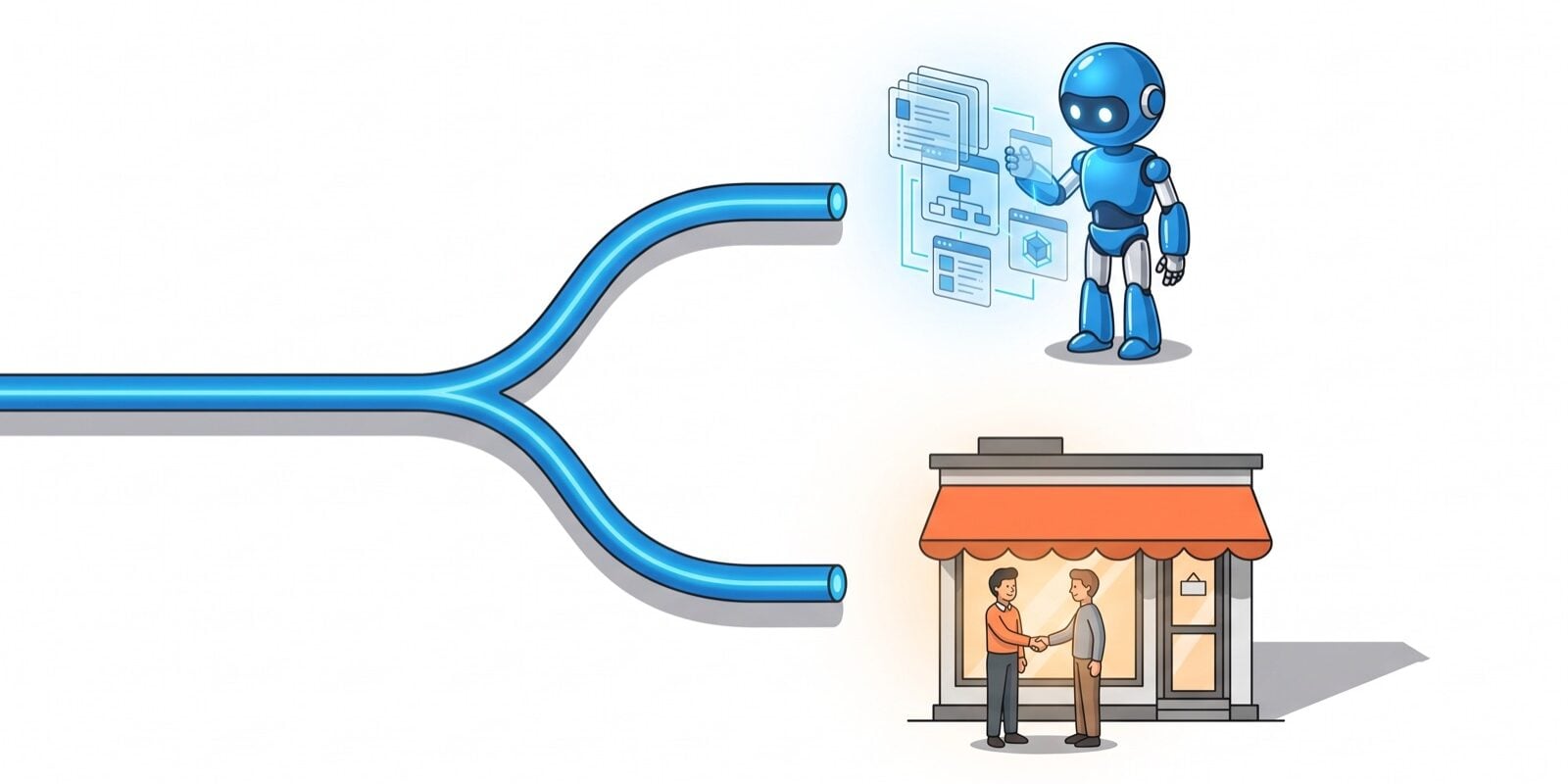
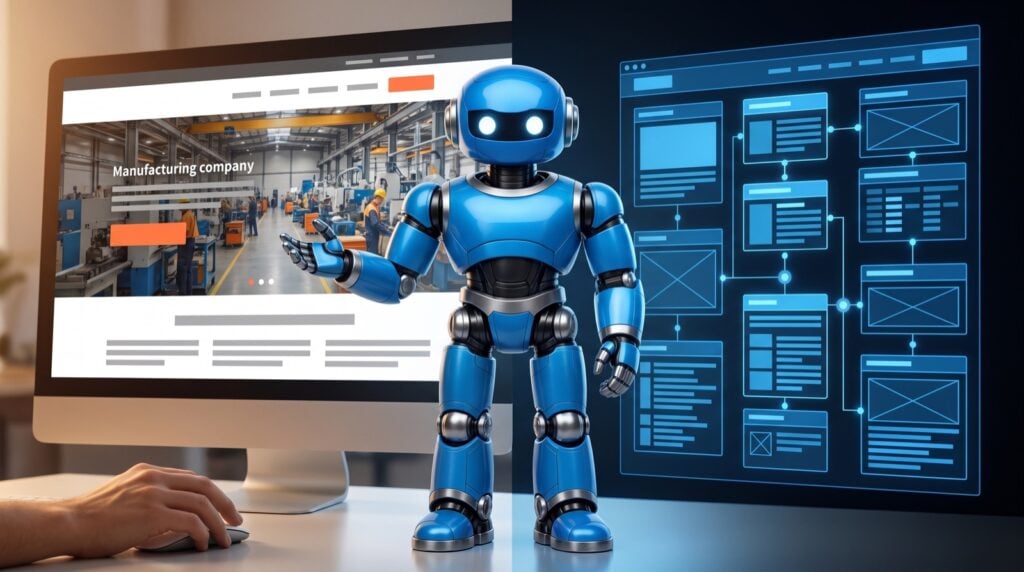
That is what we mean when we say the internet is splitting into bot websites and human websites. A bot website is the version of your site that AI crawlers and agents read: the structure, the facts, the data. A human website is the version people see: the design, the story, the trust signals. They live at the same URL, but they are consumed by two completely different audiences with completely different needs.
At Running Robots, this split is now the organizing idea behind how we build websites, how we do search optimization, and how we produce content for Iowa manufacturers and B2B companies. This post explains what the split looks like from where we sit, why we think it is permanent, and how we have changed our own services to build for it.
The Bots Already Outnumber the People
For most of the web’s history, “traffic” meant people. That flipped this year. On June 3, 2026, Cloudflare reported that automated requests made up 57.5% of HTML web traffic across the roughly one-fifth of websites it sits in front of, versus 42.5% from humans. Bots are now the majority visitor, not the edge case.
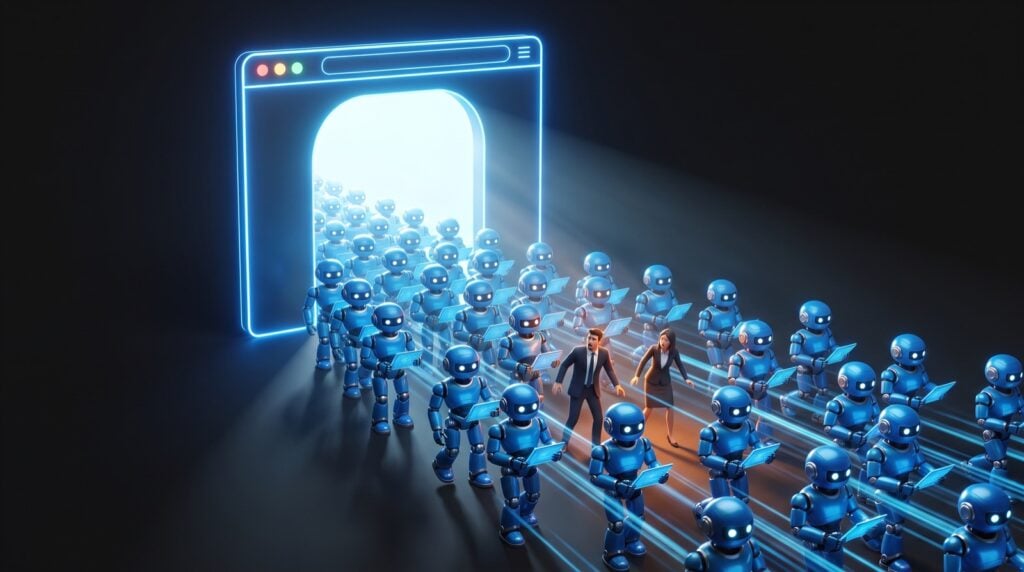
The composition of that bot traffic matters more than the headline. Cloudflare’s May 2026 crawler data showed that 51.8% of AI crawler requests are for model training and only 9.3% are for search. In plain terms, most of the machines reading your site are not trying to send you a click. They are trying to learn what you sell, what it costs, how it compares, and whether you should be mentioned the next time a buyer asks.
Those crawlers are also stingy with referrals. The same Cloudflare data put Anthropic’s ClaudeBot at roughly 24,000 pages crawled for every one visitor referred back, compared with about 5 pages per referral for traditional Google search. That ratio is the whole story of the split. The bot reads everything and sends almost nobody. Its “visit” produces an opinion about you, not a session in Google Analytics.
We have watched this play out in client accounts at Running Robots. Organic sessions flatten while quote requests keep arriving, and when we ask the buyer how they found the company, the answer is increasingly “I asked ChatGPT” or “it came up in an AI Overview.” The work happened. The visit did not.
What a Bot Website Needs From You
A bot does not browse. It ingests. When an AI agent hits your product page, it is running a checklist: What is this product? Who is it for? What are the specifications? How does it compare? Where is the proof? If your page answers those questions in clean, extractable text, you get cited. If the answers live in a PDF brochure, a JavaScript slider, or the head of your sales manager, you get skipped.
This is why the bot website rewards things that human-first design has spent twenty years hiding:
- Plain factual sentences. “Rated for 2,500 hours of salt spray per ASTM B117” gets cited. “Built to last” does not.
- Segment-specific language. A manufacturer that says which operation type a product fits, using the buyer’s own terminology, gives the bot a match it can make. Generic copy gives it nothing to grab.
- Structured data. Schema markup tells a machine what your business is, what you sell, and where you are, without asking it to infer.
- Consistency across the web. AI systems corroborate. If your website, your directory listings, and your reviews disagree, the bot trusts none of them.
We covered the technical side of this in our post on optimizing your website for humans and AI. The point here is different. The bot website is not a technical add-on to your real website. It is a second product with its own audience, and for many B2B companies it is already the larger one.
What a Human Website Still Needs
None of this means the human website is dead. When the AI assistant hands a buyer a shortlist of three suppliers, that buyer still clicks through to decide who to call. The human website’s job has narrowed, and it has gotten harder. It no longer has to be found. It has to close.
That changes what good design means. A person arriving from an AI recommendation already knows what you make. They are checking whether you are real, whether you are credible, and whether you are easy to work with. Photos of your actual shop floor, named people, a phone number that gets answered, and a quote form that does not fight them all matter more than a clever headline.
At Running Robots we now build the human layer for exactly that moment: the last five minutes before someone decides to contact you. Our website design work starts from the bot’s shortlist and asks what a skeptical buyer needs to see to pick up the phone.
The Two-Website Theory, and What It Means for SEO
We call this framework the Two-Website Theory: every business website is now two products at one address, a bot website that gets you recommended and a human website that gets you chosen. You have to design, measure, and pay for both on purpose, because neglecting either one silently kills the other.
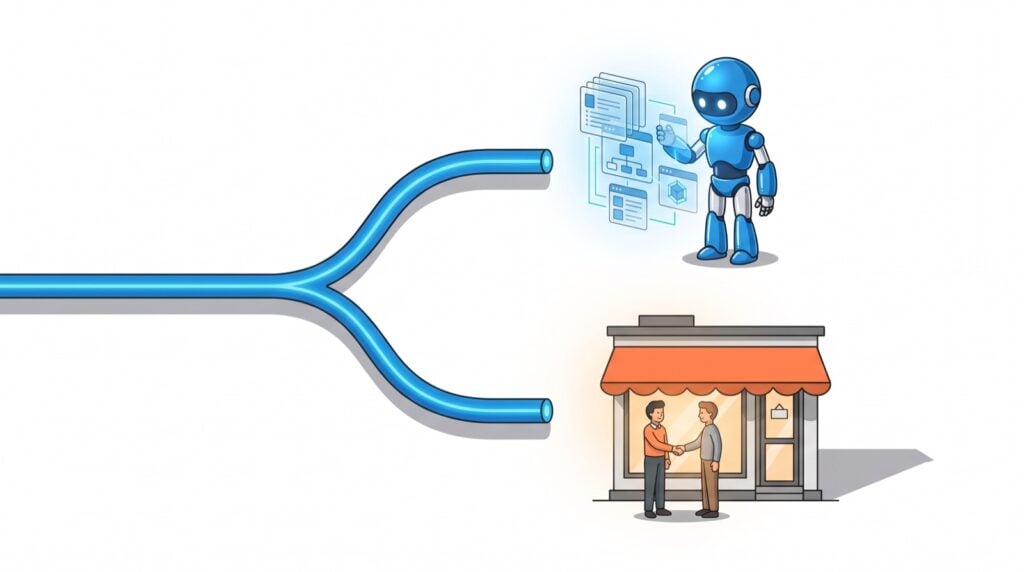
Under that theory, traditional search engine optimization (SEO) is necessary but no longer sufficient. Ranking on page one still matters, and the fundamentals of technical SEO are what make a site readable to any crawler, human-facing or not. But the goal has widened. The question is no longer just “Where do we rank?” It is “When a buyer asks an AI assistant about our category, do we come up, and is what it says about us accurate?”
That second question has its own disciplines. Answer engine optimization (AEO) is the practice of structuring content so AI systems can extract and cite it directly. Generative engine optimization (GEO) is the broader work of shaping how you are represented inside AI-generated answers. Both sit on top of SEO, and both depend on the bot website being in order.
So Running Robots is changing how we sell search optimization. Instead of quoting “SEO” as a monthly bundle of on-page fixes, we are packaging it as visibility across search engines and AI answer engines together. That starts with a simple test we now run for every prospect: open an AI assistant in a fresh session and ask it about your company and your category. What it says, and what it leaves out, is the real baseline.
Our SEO services still do the foundation work. What is new is that the foundation is measured against AI answers, not just rankings.
Content Is How You Feed the Bot
Here is the part most companies miss. Technical structure gets the bot in the door. Content is what it actually eats.
When we studied why some businesses appear in AI Overviews and others do not, the pattern was consistent: the ones that showed up had published articles that gave the AI the context it needed. The ones that did not left a vacuum, and the AI filled it with whatever it could find, which usually meant forums, review sites, and third-party sellers using the brand’s own name. If you do not describe your products in your own words, someone else’s words get used.
This is also why we think the old way of selling content, by the article, is finished. A blog post is not the asset. The asset is the trained body of knowledge that produced it: your terminology, your customer segments, your product positioning, your objections and answers, in a form a machine can use over and over.
So Running Robots has changed how we sell content too. Instead of a count of articles, we now sell a training engagement. Over roughly six months, we work with your team to capture how you talk about your products and your customers, publish a series of articles that teach the AI ecosystem who you are, and build a content model that has learned your voice. At the end you have something you own: a system that can draft the next article in your language, whether we run it for you or you run it yourself. Our content creation services page has the details.
The articles still matter. They are how the knowledge gets into the bot website. But the training is the product.
How We Are Building for the Split
We would not write this post if we were only theorizing. Over the past year Running Robots has rebuilt our own operations around the Two-Website Theory, and the pieces are worth naming because they show what “building for bots” looks like in practice.
Every client we work with now has a structured, machine-readable record of their business that our team and our tools read from: their pages, their keywords, their campaigns, their meeting notes, their goals. That record is what our content model trains on, so what we publish about a client is grounded in what is actually true about them, not what a language model guessed.
Every report and every article passes through a human review step before it goes anywhere. Machines do the ingesting and the drafting. People do the judging. We learned the hard way that an unreviewed automated report reads as exactly that to a client, and the same will be true of your content when a buyer’s AI reads it.
And we have started running our own new services on Running Robots first, before any client sees them. If a product does not survive contact with our own bot website and human website, it does not ship.
Ask Your Website Two Questions
You can test the split yourself in ten minutes. First, open an AI assistant in a fresh session and ask it what your company does, who your products are for, and how you compare to alternatives. That is your bot website talking. Second, hand a stranger your homepage on a phone and ask them what they would have to do to get a quote. That is your human website talking.
If either answer makes you wince, that is the gap. Running Robots has spent 12+ years helping Iowa businesses get found online, and we now build for the audience that does the finding on a person’s behalf. We would be glad to run both tests with you and show you what we see.
Book A Free Consultation With Us Today! Start here and we will walk through your bot website and your human website side by side.


