














You built your website to convince people. To make a strong first impression, answer questions, and turn visitors into customers. That’s been the playbook for two decades, and it still matters. But there’s a problem: the first “visitor” to your site increasingly isn’t a person at all.
It’s a bot. An AI system crawling your pages, extracting your content, and deciding whether to recommend your business when someone asks a question through ChatGPT, Google’s AI Overview, or Perplexity. This process is called generative engine optimization (GEO), and it’s the other half of how AI is changing marketing in 2026. GEO is the practice of structuring your content so AI platforms cite you as a source when generating answers for users. Understanding AI website optimization is crucial for adapting to this new landscape.
At Running Robots, we’ve been watching this shift closely. The businesses that understand it early are going to have a serious competitive advantage. The ones that don’t will watch their traffic decline and wonder what happened.
AI website optimization is crucial for adapting to this new landscape.
The Numbers That Changed Everything in AI Website Optimization
In March 2026, Cloudflare CEO Matthew Prince dropped a stat at SXSW that got the entire marketing world’s attention: AI bot traffic will exceed human traffic on the internet by 2027. That projection came from a company that sits between roughly 20% of all websites on earth and the traffic hitting them. It’s not speculation. It’s pattern recognition on a massive scale.
AI website optimization involves ensuring your content is easily reachable and understandable by AI systems.
Around the same time, Gartner published a forecast: organic search traffic to commercial websites will decline 25% by the end of 2026 as AI-powered answer engines absorb a growing share of information-seeking queries.
If your website isn’t optimized for AI, you don’t exist in that conversation about AI website optimization.
And the scale difference is staggering. A human shopping for industrial equipment might visit five websites. An AI agent performing that same task scans up to 5,000 sites in seconds, comparing data and pulling recommendations. The bot doesn’t care about your logo or your hero image. It cares about whether your content is structured, accurate, and authoritative enough to cite.
Your digital marketing strategy needs to account for AI website optimization.
Understanding AI Website Optimization
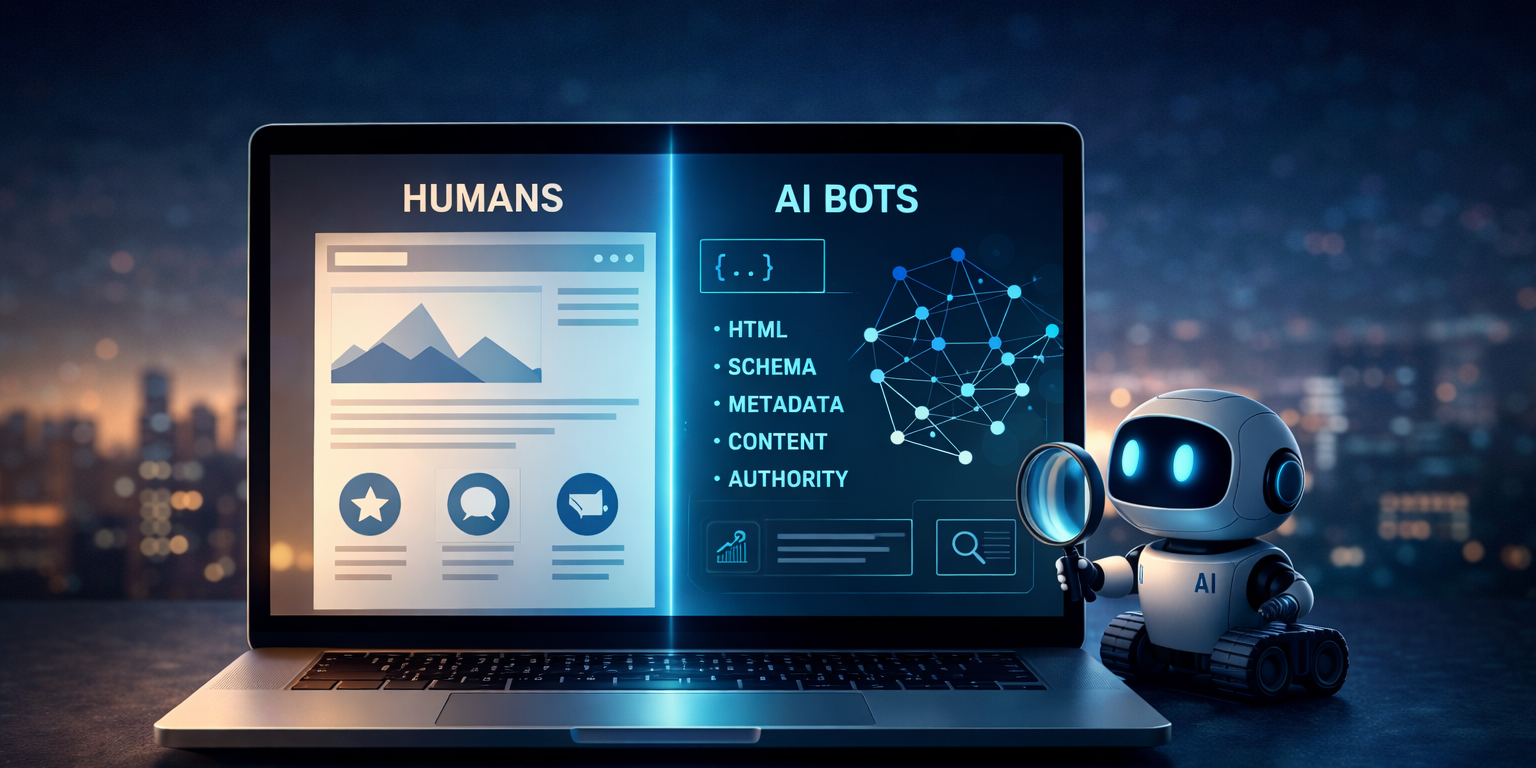
The core challenge is straightforward: humans and AI bots want the same information from your website. They just consume it in completely different ways.
| Human Visitors | AI Bots | |
|---|---|---|
| How they arrive | Google search, social media link, ad click | Crawling your pages, scraping content, responding to an AI search query |
| What they notice first | Design, images, headline, overall feel | HTML structure, schema markup, metadata |
| How they read | Skim headings, scan for relevance, read what catches their attention | Parse the full page, extract structured data, evaluate authority signals |
| What builds trust | Professional design, testimonials, brand quality | Citations, structured data, factual consistency, E-E-A-T signals |
| What drives them away | Slow loading, cluttered design, irrelevant content | Broken code, JavaScript-hidden content, missing schema, vague answers |
| What they do next | Call you, fill out a form, make a purchase | Cite you in an AI answer, recommend you to a human, or skip you entirely |
Both audiences are looking for clear, authoritative, relevant information regarding AI website optimization.
Effective AI website optimization will ultimately lead to better visibility for both humans and AI bots.
Your website needs to speak both of those languages. Most websites today only speak one.
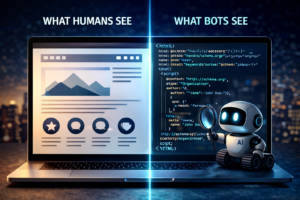
AI website optimization visual showing a robot analyzing a webpage with structured data and design elements
What AI Bots Actually Want From Your Website
AI website optimization is essential to meet AI system requirements.
Clean, accessible HTML. AI crawlers like GPTBot, ClaudeBot, and PerplexityBot don’t execute JavaScript the way Google’s crawler does. If your main content loads after the page renders, or requires user interaction to appear, it’s invisible to most AI systems. Server-side rendering isn’t optional anymore.
Schema markup. This is structured data embedded in your site’s code that tells machines exactly what your business is, what you offer, your location, your hours, your reviews. Without it, a bot has to guess. With it, the bot knows. Running Robots builds website integrations with this kind of technical infrastructure baked in.
Direct, specific answers. AI systems extract and cite content that directly answers a question in one to three clear sentences. Vague marketing language gets skipped. Specific, factual statements get cited. “We offer great customer service” is invisible to a bot. “Running Robots provides managed WordPress hosting with 24/7 uptime monitoring and same-day support response for care plan clients” gives the bot something to work with.
Speed. AI crawlers operate on tight timeouts, typically one to five seconds. If your site takes eight seconds to load, the bot moves on. Site performance has always mattered for humans. Now it’s a hard requirement for bots too.
Authority signals. Real credentials, specific claims backed by data, consistent business information across the web (name, address, phone number), and content that cites its sources. AI systems preferentially cite content that itself references authoritative sources. It’s a trust chain.
What Humans Still Need (and Always Will)
Integrating AI website optimization into your strategy can amplify your reach.
Here’s the good news: the human side of your website hasn’t fundamentally changed. People still need the same things they’ve always needed.
Design that earns trust in seconds. A visitor decides whether your business is credible before they read a single word. Professional website design isn’t decoration. It’s your first argument.
Content that addresses their specific problem. Not your company history. Not your mission statement. Their pain point, reflected back to them with a clear solution attached.
A clear path to the next step. Whether that’s calling your office, filling out a contact form, or requesting a quote, the visitor should never have to hunt for how to reach you.
Social proof. Testimonials, client logos, case studies, years in business. Running Robots has served 100+ Iowa-based businesses across manufacturing, construction, education, and more. That kind of track record matters to a human evaluating whether to pick up the phone.
A mobile-first experience. Over half your traffic is on a phone. If your site doesn’t work beautifully on mobile, you’re losing people before they even engage.
The human side hasn’t changed. The bot side is what’s new. You need both working together.
From SEO to GEO (and Why You Need Both)
If you’ve invested in search engine optimization (SEO), that investment isn’t wasted. Traditional SEO is still the dominant force for local search, high-intent product queries, and transactional searches where someone is ready to buy. When a manufacturer in Cedar Rapids searches “WordPress developer near me,” SEO is what puts you in front of them.
But GEO is rapidly becoming essential for a different category of searches: complex research queries, B2B vendor comparisons, and the kind of questions where someone asks an AI system, “What should I look for in a digital marketing agency?” If your content isn’t structured for AI citation, you’re invisible in those conversations.
These aren’t competing strategies. They’re complementary layers. SEO gets you ranked. GEO gets you cited. Together, they cover the full landscape of how people (and bots) find businesses in 2026.
Both SEO and AI website optimization work in tandem to enhance your online presence.
At Running Robots, we’ve been building AI-ready content strategies since AI Overviews first started reshaping search results. The difference now is that AI citation isn’t a bonus. It’s becoming a primary channel.
Three Strategies for Effective AI Website Optimization
You don’t need to rebuild for AI website optimization but you can enhance your site with simple changes.
Start focusing on AI website optimization to prepare for future trends.
- Audit your structured data. Does your website have schema markup? If you’re not sure, it almost certainly doesn’t. Schema is the foundation AI bots need to understand your business. Your web developer can check this in under an hour, and implementing basic schema (business info, services, FAQs) is one of the highest-impact, lowest-cost improvements you can make.
- Answer the exact questions your customers ask for AI website optimization. Create dedicated content that directly answers specific questions related to AI website optimization.
- Ask your web team about server-side rendering for AI website optimization. Your website must load main content for AI bots, ensuring it’s visible for AI website optimization.
Not sure where your site stands? Running Robots can audit your website’s AI-readiness and build a strategy that reaches both audiences.
Our consultations can help identify gaps in your AI website optimization strategy.
The Websites That Win in AI Website Optimization Will Speak Two Languages
To succeed, businesses must embrace AI website optimization as a fundamental practice.
The internet is being rebuilt around AI. Not someday. Right now. The businesses that recognize their website has two audiences, and build for both of them, are going to capture traffic and leads that their competitors don’t even know they’re losing.
Your website still needs to look great, load fast, and convince a human to pick up the phone. That hasn’t changed. What’s changed is that before a human ever sees your site, a bot has already decided whether to recommend it.
Ignoring AI website optimization can lead to missed opportunities in digital marketing.
Build for both. That’s the new standard.
Ready to make sure your website works for humans and bots?
Let’s work together to enhance your AI website optimization efforts.
Book A Free Consultation With Us Today!