















You run a real Iowa business. You have a Google Business Profile. You ask for reviews when you remember to. You hired someone to “do SEO” a couple years ago. And yet when a customer searches “[your service] near me” from their phone, a competitor across town shows up in the map pack and you don’t.
That gap is what local SEO actually fixes. Local SEO is the set of signals you send to Google that decide whether your business shows up in the Google Maps pack, the localized organic results, and increasingly, the AI-generated answers from Google AI Overviews and ChatGPT. It’s not a one-time setup. It’s a maintained system, and in 2026 the rules have shifted in ways most Iowa business owners have not caught up with yet.
This is the version of “how local SEO works in Iowa” we’d write for a friend who owned a small business and wanted a straight answer. Running Robots has worked with 100+ Iowa businesses on SEO, PPC, content, and web design since 2008, so the playbook below is what we see actually moving the needle this year, not generic advice you’ll find on every other agency blog.
What is local SEO and why does it matter for Iowa businesses?
Local SEO is the process of optimizing your online presence so you appear in geographically relevant search results: the Google Maps pack (the three map listings at the top of local search) and the localized organic results below it. For Iowa businesses, that means showing up when a real Iowa customer searches for what you do, where you do it.
What’s different in 2026: search behavior has changed. Google reports that nearly half of all searches have local intent, and a high percentage of those searches result in a contact or visit within 24 hours. Add the rise of Google AI Overviews and Gemini-powered Maps, and businesses with complete, well-maintained local signals are now getting recommended in conversational AI answers like “what’s the best HVAC company near me in Cedar Rapids?”
The opposite is also true. If your local signals are weak, you don’t just rank lower. You get replaced. AI systems pull the businesses that look most authoritative and skip the rest.
How does Google decide who shows up in the Iowa map pack?
Google ranks businesses in the local pack using three pillars: relevance (how well your business matches the search), distance (how close you are to the searcher), and prominence (how well-known and trusted Google thinks your business is).
Distance, often called proximity, is the dominant raw factor. Whitespark’s 2026 Local Search Ranking Factors survey, which polls 47 local SEO experts annually, attributes roughly 55% of Maps ranking influence to proximity alone. You can’t change where your business sits on a map, so the practical question is: of the factors you can influence, where does the weight actually fall?
Source: Whitespark 2026 Local Search Ranking Factors Report, based on Darren Shaw’s annual survey of 47 local SEO experts.
A few things jump out. Your Google Business Profile is the single biggest controllable lever, almost a third of your local ranking comes from one free Google tool that most Iowa businesses haven’t touched in months. Behavioral signals have quietly become a real factor. Citations still matter for the foundation but no longer carry the weight they did a decade ago.
If you have limited time and budget, this table tells you where to spend it. The math is not subtle.
The Four Fundamentals of Iowa local SEO
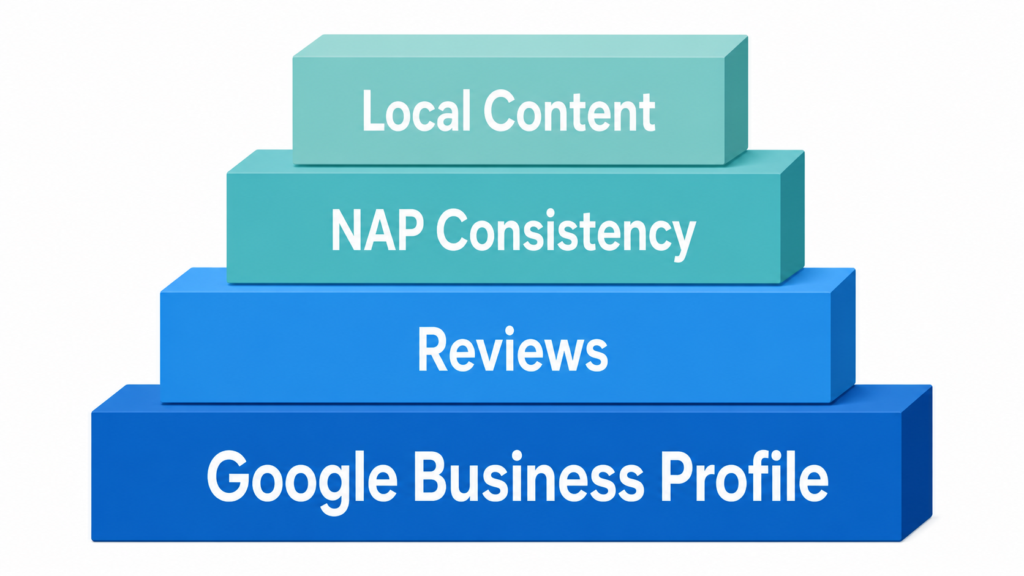
The weighting above points to four areas that, done well, account for the majority of what you can actually move. We call these the Four Fundamentals because every Iowa business we’ve helped rank locally, regardless of industry, has built ranking on the same four pieces. Skip one and the others underperform.
1. A complete and maintained Google Business Profile
A fully optimized Google Business Profile in 2026 is a complete, active, accurate, continuously maintained listing. It includes every service you offer with descriptions, accurate service area boundaries, a fresh photo library, regular Google Posts, a populated Q&A section, and a consistent pattern of review responses. Google reads all of that as input.
Here’s what “complete” actually means:
- Categories. Your primary category is the single most important relevance signal you control. Pick the one Google offers that most closely describes your core service. Add secondary categories for adjacent services you also want to be found for.
- Services list. Every service with a clear name and short description. Most Iowa businesses fill in two or three and stop. Businesses that fill in 15-20 with real descriptions tend to rank for many more long-tail searches.
- Service area. If you serve multiple Iowa cities (say a plumber working across Iowa City, Coralville, North Liberty, and Tiffin), define each one in service area settings. Don’t just list “Iowa.” Specificity wins.
- Photos. Add interior, exterior, team, before-and-after, and product photos. Aim for fresh uploads every month, not a one-time batch from 2020.
- Google Posts. Free local Tweets. Promotions, news, photos, events: anything that signals an active business. Weekly is the right cadence.
- Q&A and attributes. Seed your own questions and answer them in detail. Fill in every applicable attribute (veteran-owned, wheelchair accessible, open weekends, and so on). Both are direct ranking signals for filtered and AI-conversational searches.
If you do nothing else after reading this, audit your profile against this list. In our experience, most Iowa profiles are missing roughly 40 to 60 percent of the elements above.
2. Steady review velocity, not just review count
The biggest shift in local SEO since 2023 is how Google weighs reviews. Whitespark’s 2026 data and supporting analysis from BrightLocal both point to review velocity, the steady flow of new reviews over time, mattering more than absolute count.
In practical terms, a business with 80 reviews and a consistent flow of 6 to 8 new reviews a month now tends to outrank a business with 200 reviews and nothing new in six months. Google reads recent review activity as a signal that the business is active, engaged, and serving customers right now. A high count with no recent activity reads as stagnation.
What works for our Iowa clients:
- Build a short, branded review link. Google gives you one. Make it short and easy to share.
- Ask at the right moment. Right after a positive interaction: invoice paid, project complete, problem resolved. Not weeks later.
- Use the channel the customer already uses. SMS for trades and home services. Email for B2B. In-person handoff for retail and hospitality.
- Make the ask short. “Mind taking 30 seconds to leave a Google review? Here’s the link: [URL]” beats a multi-paragraph explanation.
- Respond to every review. Positive ones with a thank you, negative ones with a calm public acknowledgment. Response rate is itself a ranking factor in 2026.
The system doesn’t need to be complicated. It does need to actually run. Most Iowa businesses either have no system at all or had one that fell apart six months ago.
3. Consistent NAP data across directories
NAP stands for Name, Address, Phone number. NAP consistency means every directory listing, data aggregator, and reference to your business on the web uses the exact same version of those three pieces of data. When they don’t match, Google interprets the inconsistencies as either potentially different businesses or as an unreliable data source, and your rankings get suppressed.
How this happens is not malicious. It’s just time. Over years your business gets listed across 50, 100, sometimes 200 directories: Yelp, BBB, Apple Maps, Bing Places, industry-specific directories, city chamber sites, old aggregator entries, scraped data feeds. You move offices. You change phone providers. You go from “ABC Plumbing” to “ABC Plumbing and Heating.” None of those changes propagate automatically.
The cleanup pattern:
- Audit. Pull the current state of your listings across major directories and aggregators. BrightLocal, Whitespark Local Citation Finder, and Yext can do this in bulk.
- Prioritize. Google Business Profile, Apple Maps, Bing Places, Facebook, and the major aggregators (Data Axle, Foursquare, Localeze) matter most. Fix high-weight sources first.
- Iowa-specific citations worth getting on. Your local Chamber of Commerce, the Greater Des Moines Partnership (for metro businesses), the Iowa Association of Business and Industry (for B2B), and your local Better Business Bureau add real local authority. These signal “actually operates in Iowa” to Google.
- Monitor. New citations pop up. Old data gets refreshed by aggregators. Re-audit every 6 to 12 months.
4. Location-specific content on your own website
The on-page signals that move local rankings come from content that clearly signals “this business does this service in this place.” Google ranks pages, not businesses, and the pages that win local search are the location-specific ones.
Three content types actually move the needle:
- Service + location pages. If you serve multiple Iowa cities or regions, build a dedicated page for each significant one. A page targeting “plumber in Iowa City” needs to be substantively different from “plumber in Cedar Rapids,” not a copy-pasted template with the city swapped. Real local detail, neighborhood references, local landmarks, real local customer scenarios. Google’s spam filters now actively penalize boilerplate doorway pages.
- Service pages with local intent. Your main service pages should reference the geographies you serve, name local context where natural, and include a NAP block and an embedded Google Map.
- Localized blog content. Topics that combine your service with Iowa context: Iowa weather effects, seasonal trends specific to the state, local regulatory changes. “How Iowa winters affect roofing repair timelines” beats “winter roofing tips” because it lives in the search intent Iowa customers actually have.
Our content creation services at Running Robots are built around this kind of conversion-focused, intent-matched writing. Quick honest note on a related myth: more content does not mean better rankings. Google’s helpful content systems now penalize thin or duplicate pages. Two strong, locally relevant pages outperform 20 thin ones.
How Iowa metro market dynamics affect your timeline
Realistic timelines for local SEO results vary more by Iowa metro than most people realize. Here’s what we see in practice across the state:
Des Moines metro (including West Des Moines, Ankeny, Urbandale). The most competitive Iowa market for local SEO across nearly every category. Trades, healthcare, legal, and home services all have well-optimized incumbents that have been investing in local for years. Realistic timeline to break into the map pack for primary competitive terms: 4 to 6 months of consistent work. Secondary keywords move faster, often in 60 to 90 days. The Polk County area has enough searcher density that small ranking gains drive meaningful lead volume.
Cedar Rapids metro (including Marion, Hiawatha). Slightly less saturated than Des Moines but the medical and aerospace/manufacturing categories are competitive thanks to anchor employers like UnityPoint Health St. Luke’s, Mercy Medical Center, and Collins Aerospace driving services demand around them. Timeline to map pack movement: typically 3 to 5 months. Local link opportunities through the Cedar Rapids Metro Economic Alliance and the Corridor Business Journal carry real weight here.
Iowa City and Coralville corridor. Distinct market dynamics because of the University of Iowa, UI Hospitals, and the high concentration of professional services. Search behavior skews longer in the consideration window and search volume is more seasonal, peaking around academic-year transitions. Map pack competition for professional services (legal, financial, healthcare) is significant. For trades and consumer services, smaller competitive fields mean faster wins, often in 60 to 90 days.
Quad Cities (Davenport, Bettendorf). Cross-state metro that adds a wrinkle: businesses need to optimize for both Iowa and Illinois searcher intent and citations. Less saturated than Des Moines on the Iowa side, but the Illinois side adds complexity. Timeline ranges 3 to 5 months for most categories.
Smaller Iowa markets (Ottumwa, Marshalltown, Muscatine, Burlington, Mason City, Dubuque). This is where local SEO wins are easiest and most overlooked. Fewer well-optimized competitors means the same work that takes 4 to 6 months in Des Moines often produces map pack movement in 30 to 60 days. If you’re a business in one of these markets and not in the map pack, you’re leaving the easiest local SEO wins on the table.
A few patterns to set expectations regardless of market:
- Newly verified Google Business Profiles need ~30 days before they’re fully trusted. Use that time to complete every element of the profile.
- The first signs of progress are not rankings. Direction requests, profile views, and “discovery” search appearances in GBP Insights all move before your map pack rank does.
- Compounding kicks in around month 6. Review velocity, citation consistency, GBP completeness, and link signals reinforce each other. Six-plus months of consistent maintenance is when ranking improvements start looking exponential rather than linear.
If a marketing agency is promising you Iowa map pack dominance in 30 days, the right question is what corners they’re cutting to make that claim plausible. Usually the answer is review buying, fake citation building, or pure exaggeration.
How does local SEO connect to AI search like Google AI Overviews and ChatGPT?
The signals that drive Google Maps rankings are largely the same signals that drive AI citation in 2026. Local SEO and Generative Engine Optimization (GEO) have effectively converged. A business with a complete Google Business Profile, consistent NAP data, real review velocity, and structured content is positioned to win in both traditional map pack search and AI conversational search.
The reason is mechanical. AI systems like Google’s Gemini (now powering Google Maps’ “Ask Maps” feature), ChatGPT’s web browsing, and Perplexity all rely on entity authority: independent sources corroborating the same information about your business. A business mentioned consistently across Google Business Profile, Yelp, your local chamber, and your own well-structured website reads as authoritative. A business with conflicting or missing information across those sources is skipped.
What this means in practice for Iowa businesses:
- If you’ve built the Four Fundamentals, you’re already most of the way to GEO readiness.
- Adding structured FAQ content doubles as map pack content and AI citation content.
- LocalBusiness schema, FAQ schema, and clear NAP markup help both Google Maps and AI parsers read your business correctly.
- The “Ask Maps” Gemini feature surfaces businesses with active, complete profiles and buries the rest. The gap is widening fast.
Most Iowa businesses are not set up for this. The ones investing in the foundation now are building an advantage that compounds as AI search continues to grow. The ones that wait will be competing for visibility against businesses that already exist in both traditional and AI search results.
Want to know exactly where your business stands? Our Digital Marketing Review audits your Google Business Profile completeness, your NAP consistency across major directories, your website’s local signals, and your current ranking position for the terms that matter. No sales pitch attached to the findings, just an accurate picture of where you stand and what the realistic path forward looks like.
Frequently asked questions about local SEO in Iowa
What’s the difference between local SEO and regular SEO?
Regular SEO targets searches with no geographic intent: informational queries, broad product searches, national-level commercial searches. Local SEO targets searches where geography matters: “near me” queries, “in [city]” queries, and anything Google interprets as local. The signals overlap but local SEO adds Google Business Profile work, NAP consistency, review velocity, and citation management.
Do I need local SEO if I only have one Iowa location?
Yes, especially with one location. Single-location businesses depend more heavily on map pack visibility because they don’t have multiple physical addresses to triangulate around a metro. A well-optimized profile for a single Iowa City coffee shop will outperform a neglected profile for a multi-location chain in the same market.
Can I do local SEO myself or do I need an agency?
You can do meaningful local SEO yourself. Claim and fully complete your Google Business Profile, build a review request system that runs every week, and audit your NAP consistency across the top 10 to 15 directories. Those three actions alone move the needle for most small Iowa businesses. The professional value of an agency is in depth (citation audits, schema implementation, competitive analysis) and speed.
How do I rank in the Iowa map pack?
Focus your effort in this order: complete your Google Business Profile to 100%, build a review system that runs weekly, audit and fix your NAP data across major directories, and add LocalBusiness plus FAQ schema to your website. These four actions cover roughly 80% of what drives map pack ranking in Iowa.
How often should I post to my Google Business Profile?
Weekly is the sweet spot. Daily is unnecessary. Quarterly is not enough. Pick a cadence you can actually maintain. Posts about real business activity (new services, promotions, photos of completed work, local events) perform better than generic marketing posts.
What’s the most common local SEO mistake Iowa businesses make?
Treating Google Business Profile as a one-time setup. The single most common pattern we see is a business that claimed and partially completed their profile three years ago and hasn’t touched it since, while their competitors post weekly and respond to every review. Six months in, the active business has visibly higher map pack placement with no other changes.
What to do next
Local SEO in Iowa rewards the businesses that commit to maintaining the Four Fundamentals, not the ones that try to game shortcuts. If you’ve read this far, you have a working mental model of what actually drives rankings in 2026 and where to spend effort.
The fastest action item: audit your Google Business Profile against the checklist in the first fundamental. The most valuable action item: book a Digital Marketing Review so you know exactly where your business stands and what the realistic path forward looks like.
The businesses that show up in the Iowa map pack a year from now are the ones doing the work today.
Ready to find out where you stand? Book a Free Consultation with Running Robots.