
















The biggest mistake in manufacturing marketing isn’t bad ads, weak content, or an outdated website. It’s writing for the wrong buyer. Specifically, writing for one of them when there are always three.
Manufacturing lead generation is the process of attracting, qualifying, and converting industrial buyers into request-for-quote (RFQ) submissions or sales conversations. It looks like B2B lead generation on the surface, but the mechanics are different. The buying committee is larger, the sales cycle is longer, and the technical depth required to earn trust is significantly higher.
After 12+ years building lead-gen systems for Iowa manufacturers and industrial companies at Running Robots, the pattern is consistent: the gap between average manufacturing marketing and effective manufacturing marketing is almost always about understanding the buying committee. Here’s the framework that closes it.
What is manufacturing lead generation in 2026?
Manufacturing lead generation is the set of digital tactics, including search engine optimization (SEO), Pay Per Click (PPC) advertising, technical content, and conversion-focused website design, that turn industrial buyer search behavior into qualified RFQs and sales conversations. The goal is not traffic. The goal is the right traffic from the right person at the right point in a multi-month buying decision.
The average B2B sales cycle in 2026 sits at roughly 10 months per Leadinfo’s 2026 B2B lead generation trends report. In manufacturing, that number is often longer. A potential buyer searching for a part supplier, contract machinist, or industrial equipment manufacturer in May may not actually issue a purchase order until February. Your marketing job is to be findable, credible, and useful across that entire window.
Why manufacturing lead generation is different from every other B2B funnel
A SaaS company can run a 30-day demo cycle. A consumer brand can convert a stranger into a buyer in one session. Manufacturing does neither of those things, because a manufacturing purchase is almost never made by one person.
When Sagefrog surveyed B2B manufacturing marketers for their 2026 trends report, the pattern was consistent across respondents: buying groups are getting larger and more collaborative. A typical industrial purchase now involves engineers, procurement, operations, and executive leadership, each evaluating the same vendor with completely different criteria.
If your website, ads, and content are written for one of those buyers, you’re invisible to the other two. That’s why most manufacturing marketing budgets underperform. They target a single persona in a buying decision that requires three.
The Three-Buyer Playbook: who you’re actually selling to
Every serious manufacturing lead generation strategy starts with mapping content, channels, and conversion paths to three specific buyer roles. Each role asks different questions, searches different terms, and converts on different signals.
These three searches happen at different points in the same buying decision, sometimes by the same person wearing different hats, more often by three different people inside the same company comparing notes. The companies that win the order are the ones whose website satisfies all three.
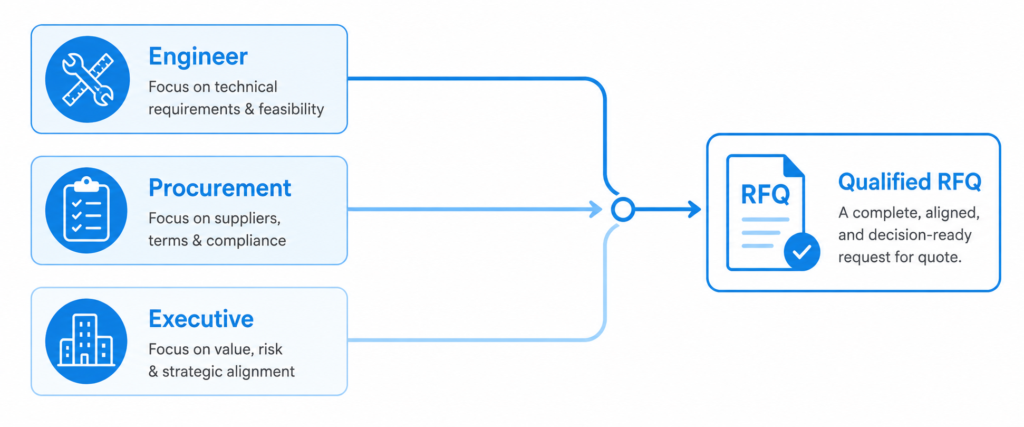
Here’s how to actually do that.
Marketing to the Engineer: specifications, depth, and findability
The engineer almost always searches first. They are looking for a vendor who can solve a specific technical problem, and they are profoundly skeptical of marketing language. They want the spec sheet, not the brochure.
This is where manufacturing search engine optimization (SEO) earns its money. Engineer search behavior is dominated by long-tail, specification-heavy queries that almost no agency content targets correctly.
What to publish for the engineer:
- Technical product or capability pages with dimensions, materials, tolerances, and certification standards listed plainly. Every spec field is a potential search match.
- Comparison content that names alternative materials, processes, or part types and explains the trade-offs. Engineers compare. Give them what they need to compare on your turf.
- Spec-driven blog content. Not “5 reasons to choose a contract manufacturer.” Instead: “When to specify 316L vs 304 stainless for food-grade applications,” the kind of question an engineer types into Google at 11 PM.
- Video walkthroughs. Equipment demos, manufacturing process tours, and quality inspection footage are increasingly preferred for technical evaluation. Engineering-driven video is one of the fastest-growing content formats in industrial buying.
The engineer almost never fills out a contact form on the first visit. They bookmark you, send the link to procurement, and come back six weeks later. Your job during that window is to be the resource they keep open in a tab.
Marketing to Procurement: trust signals, comparisons, and friction-free RFQs
Procurement enters the picture after the engineer has narrowed the field to two or three viable suppliers. Their job is to verify capability, reduce risk, and make the purchase defensible internally. They are comparing vendors on a spreadsheet.
What loses a procurement evaluation is friction, and most manufacturing websites are full of it.
What procurement needs to see immediately:
- A capabilities matrix. Equipment list, certifications, materials, finishing options, lead times. One page. Skimmable. No marketing copy required.
- Trust signals in the right places. ISO certifications, ITAR registration, customer logos, years in business, and review platforms displayed above the fold on your main service pages, not buried in the footer.
- An RFQ form that respects their time. Five fields, not fifteen. File upload for drawings. Clear next-step expectations after submission.
- Comparison content that answers the questions they will be asked internally. Why you over a competitor. Why custom over off-the-shelf. Why domestic over offshore. Procurement defends decisions. Give them ammunition.
Reshoring and supply chain resilience messaging has been outperforming innovation-led messaging across industrial campaigns in 2026. For domestic manufacturers competing against overseas suppliers, that proximity and continuity story is one of the most defensible pitches you can put in front of a procurement team. Make sure the spreadsheet they take into the meeting has your name in the column they want to recommend.
Marketing to the Executive: ROI, proof, and partnership fit
Once the engineer has validated the technical fit and procurement has cleared the risk check, the executive signs the purchase order. They are not reading your spec sheets. They are looking for confidence that this vendor will not become an operational problem in six months.
Executives buy stories that look like their own. That makes proof content the highest-leverage asset in the entire funnel.
When we rebuilt the website for one of our ag-manufacturing clients, lead generation was the explicit goal, not a redesign for its own sake. We built an interactive product configurator that let prospects spec their equipment, see an estimated price, and request a distributor contact in one motion. In the first two months after launch, traffic to the site increased nearly 70%, and the company’s most important conversion pages (Contact, Find a Dealer, Manuals) saw double-digit pageview increases. That’s a lead-gen system, not a marketing site.
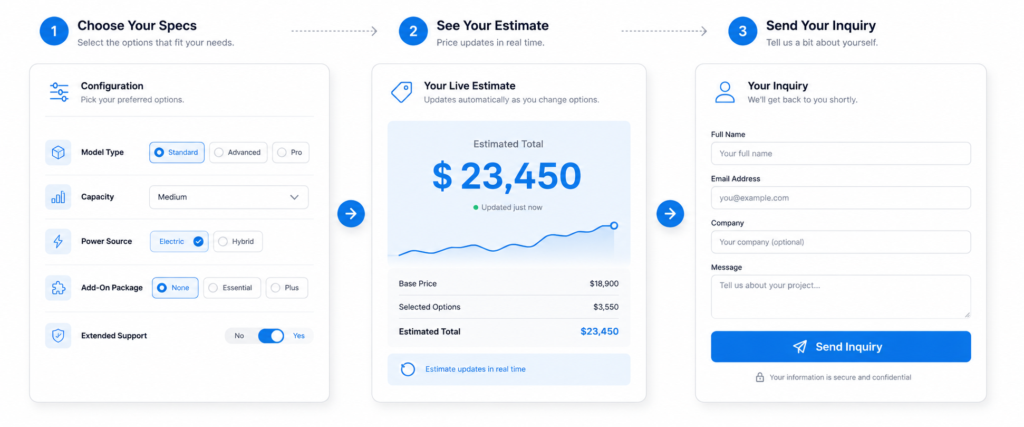
That kind of result is what an executive wants to read about another manufacturer doing, preferably one in the same state, the same industry, or the same business model. If your website does not have at least one named case study with a real number attached, you are asking executives to take you on faith. They won’t.
The other lever that matters for executive buyers is consistent visibility on the platforms they actually use. LinkedIn is the most effective social platform for B2B manufacturing lead generation in 2026, used by 86% of B2B marketers per Leadinfo, because it puts you in front of the procurement directors, plant managers, and operations VPs who form most buying committees. A thoughtful LinkedIn presence by your leadership team (not corporate posts, but specific takes on industry shifts) compounds over months into actual recognition when a buying committee meets.
What to build first: a 90-day manufacturing lead generation priority list
If you are starting from a typical manufacturing website that ranks for nothing and converts almost no one, the priority order matters. Skip the long roadmap. These five moves, in this sequence, produce results.
- Rebuild your capabilities and service pages first. Every page should have a clear H1 that matches a real search query, a capabilities matrix or spec block, and one clear next step. This is the foundation everything else links to.
- Add one specific case study to the home page. Pick the most relevant client you have permission to feature. Name them if possible, anonymize but stay specific if not. Include at least one real number. This single asset moves more executive buyers off the fence than any other change you can make.
- Fix the RFQ form. Cut the field count in half. Add a file upload. Confirm what happens next. Most manufacturing sites lose 60-80% of intent at this step.
- Start a content cadence focused on engineer-search queries. One technical post per month is enough if it is genuinely useful and properly optimized. Twelve of these in a year is how you start outranking national competitors on specification queries.
- Launch Pay Per Click (PPC) on your three highest-margin capabilities only. Not your whole catalog. Three. Tight match types, exhaustive negative keywords, conversion tracking on actual RFQ submissions. PPC works for manufacturing. It just doesn’t work when it’s run like a consumer campaign.
None of these are theoretical. They are the exact moves we run for the manufacturers and industrial clients in our portfolio. They work because they respect how the buying decision actually happens, not how marketing automation vendors wish it happened.
If your manufacturing lead generation is producing traffic but not qualified RFQs, the gap is almost always one of two things: a buying committee you’re only serving one-third of, or a website that does not give procurement and executives the proof they need to move forward. Both are fixable. You just have to stop writing for one buyer when there are always three. That kind of funnel diagnosis is exactly what a Digital Marketing Review is built to deliver.
Book a Free Consultation with Running Robots and we’ll walk through your current funnel, identify which of the three buyers your site is failing, and lay out the specific changes that will move the needle in 90 days.