















Picture an Iowa business owner four months into a twelve-month marketing contract. The reports show “rankings improving” and “impressions up.” The phone hasn’t rung any more than it did last year. The website still isn’t generating leads. The agency keeps talking about what they’re working on next month. The owner keeps writing the check, because there are still eight months left and no clear way out.
A bad agency hire is the most expensive marketing tactic there is. Worse than a wasted ad campaign. Worse than the wrong website rebuild. Because the wrong agency doesn’t just lose you money this quarter. It locks in a year of the wrong direction, and you only figure it out after the contract is signed.
This article exists so that doesn’t happen to you.
Iowa businesses get pitched by a lot of agencies. Most of those pitches sound the same. The problem isn’t that there aren’t good agencies in this state. There are. The problem is that the standard sales conversation is built to close you, not to help you tell the good ones from the rest.
A quick disclosure: we’re a marketing agency. We have skin in this game. We’re going to tell you the truth anyway, because the businesses we want to work with are the ones who can tell the difference.
The framework below is what we call The Iowa Agency Test. It’s seven questions every agency should be able to answer before you sign. It’s the same test we’d run on our own work, and we’ll show you how we score on it at the end. If an agency you’re evaluating can’t answer all seven clearly, walk away.
Key Takeaways
- The Iowa Agency Test is seven questions every marketing agency should answer before you sign. If they can’t, walk away.
- The best agency isn’t the cheapest, the biggest, or the one with the slickest deck. It’s the one that understands your business before pitching a service.
- Specifics beat slogans. If an agency answers a numbers question with a vision statement, that is the answer.
- You should own every account, every asset, and every piece of content created in your name. Always. No exceptions.
- AI Overviews now appear on roughly 48% of Google searches (Search Engine Land). Hire an agency that’s already built for AI search, not one still optimizing for 2022.
- The cheapest option usually costs the most over time. Template work creates technical debt you’ll pay to clean up later.
Is hiring a marketing agency in Iowa different from hiring one anywhere else?
Yes. Iowa is a small-business state with a heavy mix of manufacturers, ag businesses, professional services, and tourism. The agency landscape ranges from solo freelancers to multi-office firms based in Des Moines, Cedar Rapids, Iowa City, and beyond. The right agency for an Iowa business is rarely the biggest name in the SERPs.
A few things shape the Iowa market specifically.
Iowa runs on small business. The state is home to over 270,000 small businesses, employing roughly half the private workforce. Most don’t need enterprise-grade agencies built for venture-backed national companies. They need partners who treat a real marketing engagement like it matters.
Iowa buyers are relationship-driven and analytical. They want to know who’s actually doing the work. They want to talk to that person. They want answers in numbers, not slogans.
The local-versus-national question matters more here than in larger markets. According to BrightLocal’s 2023 small business survey, 62% of small businesses report higher satisfaction with local agencies than with national ones. The reasons are predictable: faster response times, in-person meetings when needed, real market knowledge, and pricing built for a Midwest economy rather than a Silicon Valley one.
That said, “local” isn’t automatically better. A local generalist can underperform a focused remote specialist. Filter for fit, not just zip code.
The seven-question framework below, what we call The Iowa Agency Test, was built around what actually works in this market.
What is The Iowa Agency Test, and how do I use it?
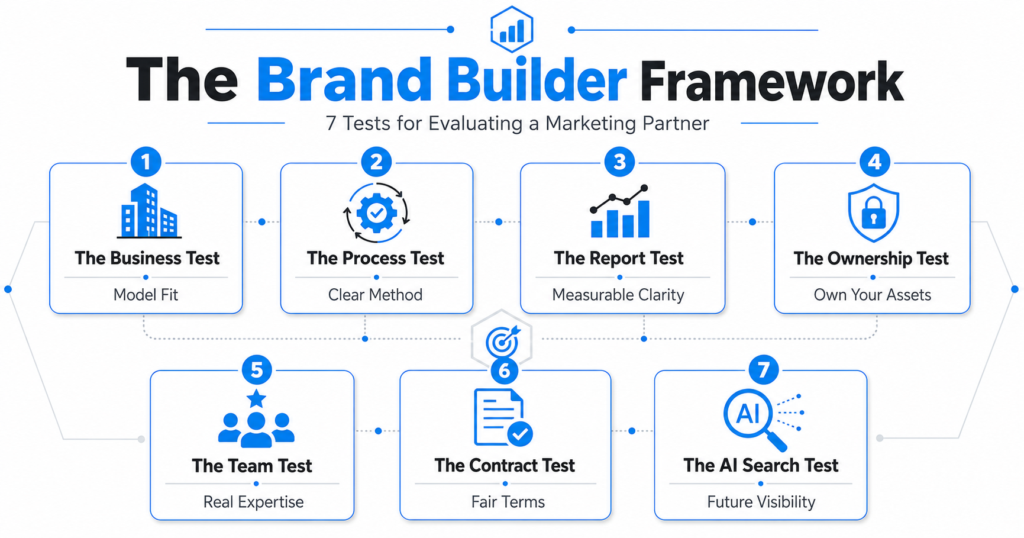
The Iowa Agency Test is seven questions every marketing agency should be able to answer clearly before you hire them. Each question is a filter. An agency that can’t answer all seven will cost you more than it earns. The seven tests cover business understanding, process, reporting, account ownership, the team, contracts, and AI search readiness.
Score each agency you’re considering on each test. Be honest. The agency with the highest total isn’t always the right answer. But a low score on the Ownership Test, the Contract Test, or the Report Test should disqualify an agency on its own.
Here are the seven tests.
Test #1: The Business Test
Will the agency keep getting smarter about your business over time?
A competent SEO or PPC manager can grow campaigns across almost any industry. The mechanics port across business types. The difference between an agency that delivers for a quarter and one that compounds for years is whether they keep investing in learning your business.
Some agencies set up a campaign, automate the reporting, and run on autopilot until something obviously breaks. Other agencies treat every month as a chance to learn more about your customer journey, your pain points, your competitors, your seasonal patterns, and the language your actual buyers use. The first kind plateaus. The second kind compounds.
The shorthand: a weak agency knows what you do. A strong agency knows what your customers care about and gets sharper at it every quarter.
Why this matters in Iowa: Iowa’s mix of manufacturers, ag operations, service firms, and tourism businesses can’t be solved with a generic playbook. A manufacturer’s buyer journey looks nothing like a tourism business’s. An agency that’s willing to invest in learning your specific industry will compound results over years. An agency that treats your account as another SEO or PPC project will plateau by year two.
What good looks like: An agency that keeps asking questions long after the kickoff. Regular conversations about what’s changed in your sales process, your customers, your industry. Recommendations that show they’ve been paying attention to your business, not just your dashboard. Twelve months in, they can name your top customer pain points without looking them up.
We treat every engagement as a partnership that compounds. The longer we work with a client, the better we know their industry, their customers, and the angles that actually convert. Fifteen-plus years of asking the right questions in Iowa means we don’t start from zero with most industries here — and we keep learning even when we don’t.
Test #2: The Process Test
Can the agency walk you through their first 90 days with a new client?
Process is the difference between an agency you can count on in year three and one you’ve already replaced.
Ask any agency you’re evaluating: “Walk me through your first 90 days with a new client.” A real answer has named phases, deliverables, kickoff meetings, reporting cadence, and review checkpoints. If the answer is “every client is different, so we customize from scratch,” that isn’t customization. That’s improvisation, and improvisation runs out of road by month six.
Why this matters in Iowa: Iowa’s marketing agency market is smaller than the coasts. You don’t have ten interchangeable agencies down the block to rotate through. Picking a partner with a process you can live with for the long haul matters more here than in markets where the next agency is always a Google search away.
The best Iowa agencies publish their methodology. Our website design work follows a five-phase build. Our SEO work runs through a three-phase methodology that takes a site from research through execution into ongoing refinement. Our care plans define exactly what happens between major engagements. If an agency can’t show you a documented process, they don’t have one.
Test #3: The Report Test
Does the agency’s monthly report tell you what changed, why, and what it cost per qualified lead?
A bad monthly report shows you impressions and ranking positions. A good one shows you what changed, why it changed, what it cost you per qualified lead, and what’s coming next. The first is data dressed up as proof. The second is intelligence you can actually use to run your business.
Vanity metrics measure activity. Impressions, clicks, and average position. Business metrics measure outcomes. Qualified leads, conversions, revenue, return on ad spend. Many agencies survive on the first kind because the second kind would expose them.
Why this matters in Iowa: Iowa buyers are analytical. They expect to be shown numbers that map to revenue. Reports that read like marketing theater don’t survive a year here.
What good looks like: Reports that tie marketing activity to revenue. A willingness to show you a sample monthly report from a real engagement, with the client name redacted. Clear explanations of which numbers tie to which business outcomes.
Ask any agency to walk you through their reporting before you sign. If conversions, qualified leads, and revenue impact aren’t the headline numbers, the rest is decoration.
Test #4: The Ownership Test
Do you own every account the agency creates in your name?
Picture this scenario. You decide to switch agencies in year three. You log into Google Ads to grant your new partner access. The account is registered under your old agency’s domain. You don’t have admin rights. They want a transition fee to release it. Your new agency has to spend two weeks rebuilding what should have taken twenty minutes.
This is real. It happens to Iowa businesses every year, and it’s completely avoidable.
Account ownership is the single most-overlooked clause in agency contracts. Some agencies set up Google Ads, Google Analytics, Search Console, and even your domain under their own corporate name. If the relationship ends, they hold leverage you didn’t know existed.
Why this matters in Iowa: Iowa small and mid-sized businesses rarely have an in-house legal team to fight over account ownership after the fact. Five minutes of clarity at contract signing prevents months of pain later.
What good looks like: Every account is set up in your name from day one. The agency is granted access. You can revoke that access at any time. No transition fees. No hostage situations.
A simple test: ask any agency you’re evaluating who owns the accounts they set up for clients. If the answer is anything other than “the client, always,” walk away. At Running Robots, we set up every account in our clients’ names. Always. No exceptions.
Test #5: The Team Test
Can you meet the people who’ll actually work on your account before you sign?
The most common bait-and-switch in this industry isn’t financial. It’s personnel.
You have a great sales conversation with one person. You like them. You sign the contract. Then you get handed off to a junior account manager you’ve never met. The person who sold you the partnership is already selling someone else by month two. Your work is being done by someone you never interviewed.
Marketing is people work. The talent and judgment of the actual humans on your account determine the results. If you can’t name them or talk to them before signing, you’re hiring blind.
Why this matters in Iowa: Iowa is a small enough business community that reputations actually travel. The person whose name is on the proposal should also be the person you might run into at a chamber event or a vendor referral two years from now. Anonymous agency work doesn’t fit how business actually gets done here.
What good looks like: Named team members. Real bios on the website. The ability to schedule a call with the people who’ll do your work before you sign anything. Defined communication cadence with a clear primary contact.
Smaller agencies often have an advantage here. When the team is ten or twelve people, you know everyone. When it’s a hundred, you know your account manager and nobody else.
Test #6: The Contract Test
Are the contract terms fair, clear, and exit-friendly?
Red flag pattern. An agency quotes you a monthly retainer. Glosses over the contract length. You only later discover you’ve signed a twelve-month lock-in with auto-renew and no exit clause. By month four it’s obvious things aren’t working. You still owe them eight more months of payments.
Contract terms are where good agency relationships get protected and bad ones get exposed. Long lock-ins with no exit clause exist for one reason: to force payment after the value has stopped.
Why this matters in Iowa: Iowa SMB budgets are leaner than national averages. A twelve-month lock-in to a partnership that isn’t working hurts an Iowa business more than it would hurt a venture-backed national company.
What good looks like: A reasonable initial commitment, typically three to six months, that gives the agency enough time to actually do meaningful work and earn the relationship. After that, terms you can actually exit. A clear termination process. No hidden fees. No surprise auto-renew. Pricing tied to a scope you can verify.
The length of the commitment isn’t the red flag. The lack of a clear exit is. A six-month commitment with a thirty-day exit clause for cause is reasonable. A twelve-month lock-in with no out-clause is a hostage situation dressed up as a contract.
Test #7: The AI Search Test
Is the agency building for the search landscape that’s already here?
By March 2026, AI Overviews appear on roughly 48% of all Google searches (Search Engine Land). The traditional click-to-rank-one model isn’t the whole game anymore. Brands cited inside an AI Overview earn real traffic. Brands that don’t get squeezed out, even when they rank well in the classic blue links below.
That’s the single biggest change in how search works since mobile-first indexing. And most agencies haven’t adjusted yet.
An agency still optimizing for the 2022 SEO playbook is selling you a strategy that’s working against the current algorithm. AI search citation is a different discipline with different signals: structured data, named author authority, content depth, entity clarity. If your agency can’t articulate how they’re optimizing for citation in AI results, they’re behind.
Why this matters in Iowa: Iowa businesses don’t have venture budgets for catch-up campaigns next year. Falling behind on AI search now is expensive to fix in twelve months. The agencies that will still be ranking in 2027 are the ones building for AI citation in 2026.
What good looks like: Active author authority work on every piece of content. Comprehensive schema markup. Content structured around the questions AI engines actually pull from.
Ask any agency you’re evaluating to walk you through their AI search strategy. If they don’t have one, they’re behind. If they do, ask them to show you the schema markup and author setup they’ve shipped on a recent client site.
The Iowa Agency Test at a Glance
| The Test | The Question | What You’re Evaluating |
|---|---|---|
| The Business Test | Will they keep getting smarter about your business over time? | Ongoing curiosity, not autopilot |
| The Process Test | Can they walk through their first 90 days? | Documented, repeatable methodology |
| The Report Test | Does their report tie marketing to revenue? | Outcome metrics, not vanity metrics |
| The Ownership Test | Do you own every account they create? | No leverage held against you |
| The Team Test | Can you meet the people doing the work? | Named team, no bait-and-switch |
| The Contract Test | Are the terms fair and exit-friendly? | Clear exit path, no hostile auto-renew |
| The AI Search Test | Are they building for AI-driven search? | Schema, author authority, citation strategy |
Run every agency you’re considering against the full list. A weak answer on any one test is a yellow flag. A weak answer on the Ownership Test, the Contract Test, or the Report Test is a deal-breaker on its own.
What questions should I ask a marketing agency before hiring them?
Each of the seven tests has a corresponding question. Ask them in your first or second conversation with any agency, in this order.
- How do you keep learning about a client’s business after the kickoff? (The Business Test)
Good answers describe ongoing curiosity — recurring conversations, learning the customer journey, evolving the strategy. Weak answers describe a one-time discovery doc. - Walk me through your first 90 days with a new client. (The Process Test)
Good answers have named phases and clear deliverables. Vague answers say “every client is different.” - What does your monthly report look like, and what’s the headline metric? (The Report Test)
Conversions, qualified leads, and revenue impact should lead. Impressions and rankings are supporting metrics. - Who owns the accounts, data, and creative assets after we part ways? (The Ownership Test)
You should own all of it. Always. - Who specifically will work on my account, and can I meet them before signing? (The Team Test)
Named team members, real backgrounds, the ability to talk to them. Anything less is hiring blind. - What’s your contract length, termination policy, and auto-renew setup? (The Contract Test)
A reasonable initial commitment with a clear exit path is the right answer. Long lock-ins with no out-clause are the red flag. - How are you preparing client sites for AI search and citation? (The AI Search Test)
Schema markup, author authority, content depth. If they can’t speak to any of those, they’re behind. - Tell me about a recent engagement that looks like ours. What worked, and what didn’t? (Bonus question)
Good agencies have stories. Bad agencies have logos.
What mistakes do businesses make when hiring a marketing agency?
The seven tests above will catch most of the structural problems. But there are three decision-making mistakes that cost Iowa businesses more than the structural ones, and they show up across every industry we’ve worked with.
Mistake #1: Hiring on the pitch, not the process. The salesperson is sharp. The proposal looks polished. The deck has clean graphics. None of that tells you anything about who actually does the work next month, what their process looks like, or whether the results will follow the promise. The pitch is a performance. The process is the product. Hire the process.
Mistake #2: Treating the agency hire as a transaction, not a partnership. The businesses that win with their agency are the ones who show up. They send the data the agency asks for. They answer questions inside of a day. They tell the agency when something changed internally. Treat the relationship like a partnership and you’ll get partnership-grade work. Treat it like a vendor relationship and you’ll get vendor-grade work back.
Mistake #3: Waiting until you’re already losing money to evaluate. Most businesses only audit their current agency when something obvious has broken. By then, you’ve already paid for months of inadequate work. The cheaper move is to run The Iowa Agency Test on your current agency every six months, whether you’re happy with them or not. If they pass, you’ve confirmed the relationship is worth keeping. If they don’t, you’ve caught the problem before it gets expensive.
How Running Robots approaches The Iowa Agency Test
A fair question to ask the agency that built this framework: how do we score on it?
We didn’t build The Iowa Agency Test to make us look good. We built it because we kept seeing Iowa businesses pay for work that didn’t pass it. We’re the agency we’d hire. Here’s how we score on each test.
We’re a digital marketing agency based in Iowa City. We’ve been doing this for over fifteen years, with over 100 Iowa-based businesses across nearly every industry the state has. Manufacturing, professional services, hospitality, retail, healthcare, finance, education, and nonprofit.
On the Business Test: We don’t run on autopilot. The longer we work with a client, the more we know about their industry, their customers, and the angles that actually convert. Fifteen-plus years in Iowa means we don’t start from zero on most industries here, and we keep learning even when we do.
On the Process Test: Our methodology is documented and public. A five-phase web design build. A three-phase SEO process that runs from research through execution into ongoing refinement. Care plans that define what happens between major engagements. You can see our process on our website, in our proposals, and in the monthly work itself.
On the Report Test: Conversions, qualified leads, and revenue impact lead every report. Rankings and impressions support the story. They don’t tell it.
On the Ownership Test: Every account we set up is in the client’s name. Always. We don’t hold leverage we shouldn’t have.
On the Team Test: We’re small enough that you’ll know the people doing your work. Named team members. Real bios. Direct contact. No bait-and-switch handoffs after the sale.
On the Contract Test: Reasonable initial commitments with clear exit terms after onboarding. No auto-renew without notice. Clear scope. Clear exit.
On the AI Search Test: Schema markup, author authority, and content built for citation are part of every engagement, not an upgrade you have to ask for. We’re building for 2027’s search landscape now.
If you’d like to talk through whether we’d be a fit for your business, book a free consultation.
Frequently Asked Questions
How long does it take to see results from a new marketing agency?
Sixty to ninety days for early signals like ranking shifts and impression growth. Four to six months for meaningful organic traffic lift. Twelve months for compounded results. Anyone promising results faster is either overpromising or selling a short-term tactic that won’t last.
Should I hire a local Iowa marketing agency or a national one?
For most Iowa small and mid-sized businesses, local. According to BrightLocal’s 2023 small business survey, 62% of small businesses report higher satisfaction with local agencies than national ones. The reasons are practical: faster response times, real market knowledge, and pricing built for the local economy. National agencies make sense only when you have very specialized needs that no local agency can meet.
What’s the difference between SEO and PPC, and which should I start with?
SEO builds a long-term asset that compounds. It takes four to twelve months to show meaningful return, but it pays dividends for years. PPC delivers immediate traffic but stops the moment you stop paying for it. Most Iowa businesses benefit from running both. PPC drives leads in the short term while SEO compounds in the background.
How do I know if my current marketing agency is doing a good job?
Three quick checks. First, is your non-branded organic traffic growing? Second, are qualified leads and conversions growing? Third, can your agency explain their work in specific URLs and specific changes, not generic talking points? If you can’t answer yes to all three, you’re paying for activity, not outcomes.
What’s the biggest mistake businesses make when hiring an agency?
Hiring on price. The cheapest agency usually delivers template work that creates technical debt you’ll pay to fix later. Spend more on the right partner. Less on multiple wrong ones.
What is AI search optimization, and does my agency need to be doing it?
AI search optimization, also called generative engine optimization or GEO, is the practice of making your content cite-worthy to AI-powered search experiences like Google’s AI Overviews, ChatGPT, and Perplexity. With AI Overviews appearing on roughly 48% of searches in 2026, yes. Your agency needs to be doing it.
Can I do my own marketing instead of hiring an agency?
Yes, if you have the time, the technical depth, and the patience to learn the tools. Most business owners discover that the hours required to do marketing well are hours they could have spent running their business. The math usually favors hiring the right partner.
The Bottom Line
Choosing a marketing agency is one of the higher-stakes decisions a business owner makes. Most people do it with a thirty-minute sales call and a gut check.
The Iowa Agency Test is a stronger framework than most businesses use. Run it on every agency you’re considering, including your current one. Score honestly. Trust the results.
An hour spent running The Iowa Agency Test before you sign is the cheapest hour of marketing work you’ll ever do.
If you’d like to talk through your specific situation, whether we’d be a fit or whether you should keep looking, we’d rather have an honest conversation than another generic pitch meeting. Book a free consultation with Running Robots