














Most Iowa business owners are not short on marketing options. They are short on a system. You can pour money into Google Ads, a new website, social posts, SEO, and the local paper all at once and still have no idea which one actually produced a customer. That missing system is the real problem, and over a year it quietly costs Iowa businesses more than any single bad campaign ever could.
Digital marketing in Iowa is the practice of using connected online channels (a website, local search, SEO, content, paid ads, and automation) to attract, convert, and keep customers in a market where local reputation and regional trust still carry enormous weight. It is not a pile of separate tactics. It is a stack, where each layer makes the one above it work better.
At Running Robots, we have spent more than 12 years building that stack for Iowa businesses, and the companies that win here are rarely the ones running the flashiest campaigns. They are the ones using modern tools (AI-assisted search optimization and marketing automation) to make every dollar measurable. This guide lays out the full picture: what digital marketing means in Iowa, the five-layer framework we use to build it, what it should cost, which layers matter most for your industry, and how the rise of AI search is rewriting the rules for every local business in the state.
What does digital marketing actually mean for an Iowa business?
Digital marketing is the set of connected online channels a business uses to get found, earn trust, and turn attention into revenue. For an Iowa business, that means a fast website, a strong local search presence, content that answers real questions, targeted paid ads, and automation that follows up with leads before they go cold.
The word that matters there is connected. The most common mistake we see is treating these as unrelated line items: ads from one vendor, a website from another, social whenever someone remembers. Nothing links, so nothing compounds, and results reset every month.
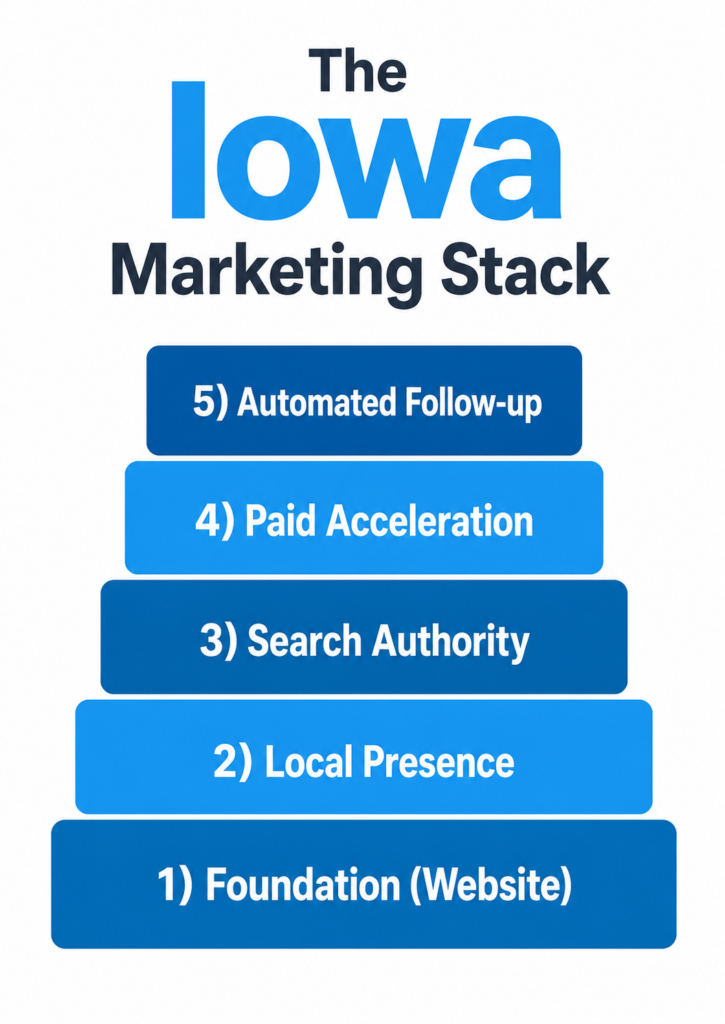
A real strategy works the opposite way. Your website is the storefront. Local search is the road signs that lead people to it. SEO and content are the salesperson who answers questions at two in the morning. Paid ads are the billboard you rent when you need traffic faster than the road signs can deliver. Automation is the follow-up call that actually closes the deal. Built together, each piece feeds the next. That layered system is what we call the Iowa Marketing Stack, and the rest of this guide is built around it.
Why Iowa is its own marketing market
Iowa is not a smaller version of a national market. It is a distinct one, shaped by specific industries, tight-knit metros, and a strong culture of local trust. Generic national marketing advice underperforms here because it ignores all three.
Start with the economy. Iowa’s real GDP reached $208.8 billion in 2025, its highest ever, according to USAFacts. Manufacturing is the single largest sector, contributing roughly $34.9 billion and employing more than 226,000 Iowans across 6,200-plus establishments, which is over 14 percent of the workforce, per Opportunity Iowa. Finance and insurance add another $31.3 billion, anchored by Des Moines, widely known as the insurance capital of the country. Agriculture makes Iowa the nation’s second-largest agricultural exporter. That mix means a huge share of Iowa marketing is B2B, technical, and relationship-driven, not consumer impulse buying.
Then there is the business base itself. Iowa is home to 272,555 small businesses, which make up 99.3 percent of all businesses in the state and employ nearly half of its workforce, according to the SBA’s 2025 Iowa profile. This is a small-business state, and small businesses buy marketing differently: tighter budgets, less tolerance for waste, and a strong preference for partners who can prove results.
Finally, reputation does heavy lifting. Roughly nine in ten consumers read online reviews before choosing a local business, per BrightLocal’s Local Consumer Review Survey. In a state where word travels fast, a handful of recent, detailed reviews can outperform thousands of dollars in advertising. National playbooks built for anonymous, high-volume consumer markets miss all of this.
The Iowa Marketing Stack: the five layers every business needs
The Iowa Marketing Stack is a five-layer model for building marketing that compounds instead of resetting. You build it from the bottom up, because each layer depends on the one beneath it. Pour traffic into a broken website and you waste it. Run ads before you can follow up and the leads leak out. The order is the strategy.
Here is the stack, bottom to top.
Layer 1 — Foundation: a website built to convert
Your website is the foundation everything else sits on. If it loads slowly, looks dated, or makes people hunt for a phone number, every dollar you spend driving traffic to it is partly wasted. The job of the foundation is simple: load fast, work on mobile, build instant trust, and make the next step obvious.
Most Iowa traffic is mobile, so a site that frustrates a phone user is losing leads before any marketing even starts. A strong foundation means clear value up top, visible proof (reviews, real photos, recognizable local clients), and one obvious action on every page. This is where conversion-focused web design earns its keep.
It starts with the right platform, because the system you build on shapes everything above it. A pretty site that does not convert is a brochure; a site engineered to turn visitors into inquiries is an asset.
Layer 2 — Local Presence: get found in your own backyard
Once the foundation is solid, the next layer is getting found locally. For most Iowa businesses, demand starts with a local search: “near me,” a town name, or a service plus a city. Local presence is how you show up in those results and in Google Maps.
The core moves are a fully optimized Google Business Profile, a steady stream of recent reviews, consistent name-address-phone information across the web, and local citations. Given that nearly nine in ten people read reviews first, review velocity alone can reshape who gets the call. This is the heart of our local SEO work.
We cover the full process in our Iowa local SEO playbook, but the principle is that local presence is the highest-leverage, lowest-cost layer for most Iowa businesses. It is often where we start.
Layer 3 — Search Authority: SEO, content, and AI citation
Search authority is how you get found beyond your immediate area and for the questions buyers ask before they are ready to call. It is built through SEO and content: pages and articles that answer real questions, rank in search, and increasingly get cited by AI systems.
This is the layer that compounds the most over time, and it is where Iowa businesses most often underinvest. Our SEO and content work lives here, building pages that target the actual questions your customers ask. That content does double duty now, ranking in traditional search and feeding the AI Overviews that sit above those results.
Building this layer is slow but durable, and it is the difference between renting attention through ads and owning it. It is also where Running Robots’ modern approach separates from traditional shops, which we will get to in the AI section below.
Layer 4 — Paid Acceleration: ads that buy speed
Paid advertising is the accelerator. When the lower layers are in place, Google Ads and paid social let you buy immediate visibility instead of waiting months for SEO to mature. The key word is accelerator, not engine. Ads driven to a weak foundation or with no follow-up burn cash fast.
For Iowa businesses, paid works best when it is tightly targeted by geography and intent, pointed at a page built to convert, and measured against leads rather than clicks. Done that way, it is the fastest path to a measurable return. Done as a standalone “let’s just run some ads” experiment, it is the most common way Iowa businesses waste marketing money.
Layer 5 — Automated Follow-up: stop leaking leads
The top layer is the one almost everyone skips: automated follow-up. Most leads do not convert on first contact, and most businesses never follow up consistently. Automation closes that gap with email sequences, CRM-driven reminders, and workflows that respond the moment someone raises a hand.
This is where Running Robots’ Zoho and automation expertise does work that traditional agencies do not touch. A connected system can route a new inquiry, send an instant reply, schedule a follow-up, and tell you which campaign produced the lead. Without this layer, the first four leak revenue. With it, the whole stack finally pays off.
Which layers matter most for your industry?
Every Iowa business needs the full stack eventually, but where you start depends on your industry and how your customers buy. A manufacturer selling six-figure equipment to engineers needs a very different emphasis than a retail shop selling to walk-in consumers.
Here is how the stack maps to the industries that drive Iowa’s economy:
| Industry | Lead layers to prioritize | Why |
|---|---|---|
| Manufacturing / B2B | Search Authority, Foundation, Paid | Long sales cycles and technical buyers reward deep content and search visibility |
| Finance / insurance | Search Authority, Local Presence, Automation | Trust-driven, compliance-aware, relationship-led decisions |
| Agriculture / ag-tech | Search Authority, Content | Niche, research-heavy buyers searching for specifics |
| Healthcare / professional services | Local Presence, Reviews, Paid | High-intent local searches and reputation-led hiring |
| Retail / eCommerce | Foundation, Paid social, Automation | Visual products, impulse and repeat purchases |
| Home services | Local Presence, Paid, Reviews | “Near me” urgency and review-led decisions |
Manufacturers deserve a special note, since they anchor Iowa’s economy. Generic consumer marketing fails them because their buyers are technical and their sales cycles are long. We built a dedicated playbook for Iowa manufacturing lead generation for exactly that reason.
What should an Iowa business budget for digital marketing?
Most small businesses should plan to spend between 7 and 10 percent of gross revenue on marketing. The U.S. Small Business Administration recommends 7 to 8 percent of revenue for businesses under $5 million, and growth-focused companies often push higher. Translated into monthly figures, that looks like this for a typical Iowa business:
| Annual revenue | Marketing budget (7–10%) | Realistic monthly spend |
|---|---|---|
| Under $250K | $17K–$25K/yr | $1,000–$2,000/mo |
| $250K–$500K | $25K–$50K/yr | $2,000–$4,000/mo |
| $500K–$1M | $50K–$100K/yr | $4,000–$8,000/mo |
| $1M–$3M | $100K–$300K/yr | $8,000–$25,000/mo |
These are planning ranges, not price tags, and what the budget buys matters more than the number. At the lower end, concentrate the money on the bottom layers of the stack: a solid foundation and local presence. As budget grows, add search authority, paid acceleration, and automation. A budget spread thin across every layer at once almost always underperforms the same money focused on the first two or three. And any partner who prices by the hour rather than by outcome is selling activity, not results.
How AI search is changing marketing in Iowa
AI has moved the finish line from “rank on Google” to “get named by the AI.” Google AI Overviews now appear on a large and growing share of searches (more than 40 percent of queries in early-2026 studies), and when one appears, the click-through rate on the top organic result falls by about 61 percent, according to Search Engine Land. In the first months of 2026, roughly 68 percent of Google searches ended without any click at all.
For an Iowa business, this is the most important shift in years. If a customer asks Google or ChatGPT “who are the best marketing agencies in Cedar Rapids” and the AI answers without anyone clicking, the only businesses that benefit are the ones the AI names. Ranking tenth is now worse than it sounds, because fewer people scroll far enough to find you.
The good news is that getting cited is a skill, not luck. AI systems pull from content that is clearly structured, answers questions directly, and cites real sources. That means definitions up front, questions answered in the first sentence, and data attributed to its origin. We break down the exact tactics in our guide on how to get cited by Google AI Overviews and ChatGPT. This is also where the gap between modern and traditional marketing is widest. An agency still focused on print and impression counts is not in this conversation at all. We have been tracking this shift closely, including at the Iowa AI Summit, and the Iowa businesses optimizing for AI search right now are claiming citations their competitors will spend years trying to win back.
Should you hire an Iowa marketing agency or build it in-house?
For most Iowa small and mid-sized businesses, an agency delivers more capability per dollar than a single in-house hire. One employee gives you one skill set and a full salary plus benefits. An agency gives you a team that covers the whole stack (web, local, SEO, content, paid, and automation) for a predictable monthly cost, with no recruiting, training, or turnover risk.
The math is straightforward. A capable full-time marketer commands a salary and benefits package well into the five figures, and that one person still cannot be an expert in every layer of the stack. Many businesses that hire in-house end up paying for a generalist and then hiring vendors anyway to fill the gaps. In-house starts to make sense only once a business is large enough to keep a full team busy, or when marketing is so central to the product that it must live in-house. Before deciding either way, it helps to know what to look for, which is why we wrote a complete buyer’s checklist for choosing a digital marketing agency in Iowa.
What digital marketing looks like across Iowa’s metros
Iowa is several markets, not one, and a smart strategy accounts for where your customers actually are.
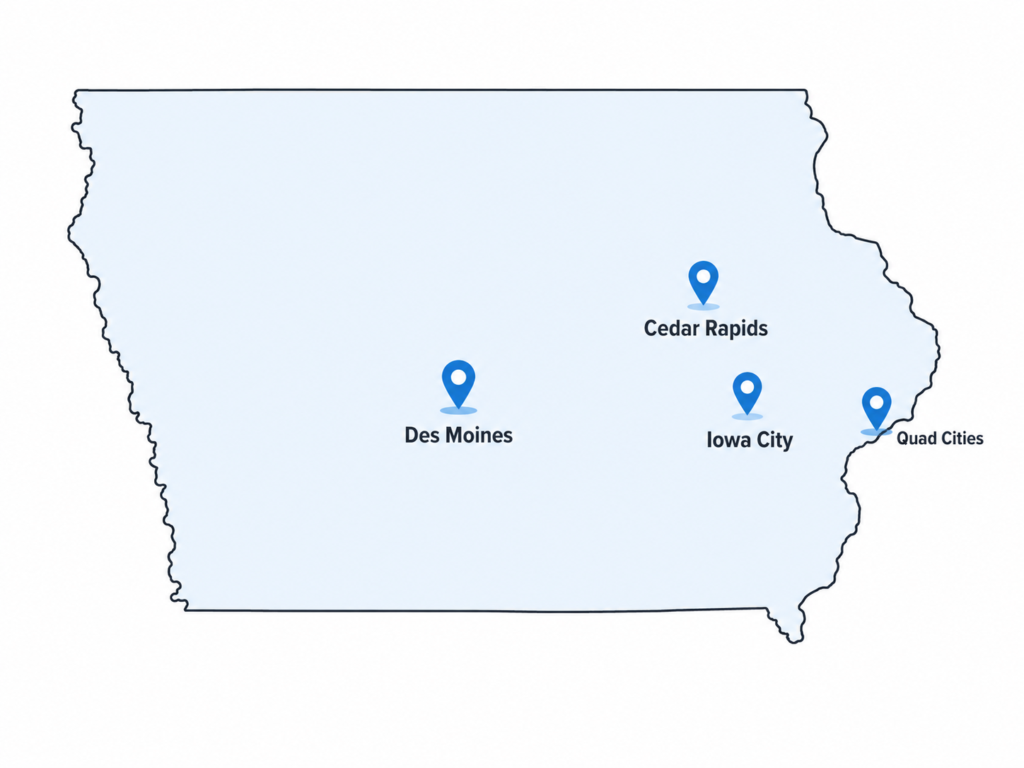
Des Moines is the largest and most competitive market and the financial heart of the state, home to a dense cluster of insurance and finance firms. Standing out there takes genuine differentiation and real search authority, because the competition is deep. Cedar Rapids and the Corridor blend manufacturing, aerospace, and food processing, and the region keeps drawing major investment, including a $750 million data center project announced in 2025. That market rewards a mix of B2B content and local presence. Iowa City is anchored by the University of Iowa and UI Health Care, the only comprehensive academic medical system in the state, which makes healthcare, education, and a dense small-business community the dominant audiences, and local presence the priority (more in our look at digital marketing in Iowa City). The Quad Cities and smaller regional hubs often have less sophisticated competition, so a well-executed local strategy can dominate faster than in the metros.
The takeaway is the same everywhere: match your message and your stack priorities to your specific metro and industry rather than running one generic “Iowa” campaign and hoping it lands.
Frequently asked questions
What is digital marketing? Digital marketing is using connected online channels (a website, local search, SEO, content, paid ads, and automation) to attract customers, build trust, and drive revenue. It replaces guesswork with measurable results, so a business can see which efforts actually generate leads instead of spending and hoping.
How much does digital marketing cost in Iowa? Most Iowa small businesses invest 7 to 10 percent of gross revenue, which works out to roughly $1,000 to $8,000 per month depending on size. The right amount depends on your margins and goals. What matters more than the number is whether the spend is concentrated on the layers of the stack that fit your business.
Is digital marketing worth it for a small business? Yes, when it is measured. A healthy marketing return for small businesses is around 5 to 1, meaning five dollars earned for every dollar spent. The businesses that lose money are usually the ones running disconnected tactics with no tracking, not the ones following a clear, layered strategy.
How long does SEO take to work in Iowa? Local SEO typically shows movement in three to six months, with stronger results building over six to twelve. Less competitive Iowa markets often move faster than Des Moines. Anyone promising page-one rankings in a few weeks is selling a shortcut that does not exist.
Build your stack, one layer at a time
If you are spending on marketing and cannot point to the leads it produces, the problem is rarely effort. It is usually a missing layer: a website that does not convert, a thin local presence, no follow-up, or content that AI search ignores. Running Robots builds the full Iowa Marketing Stack as one connected, measurable system, using the modern tools most Iowa agencies still do not touch.